
How Network TV Affiliates Work: How Stations Choose Network Shows (and When They Don’t)
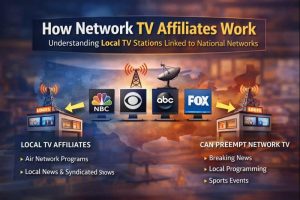
Table of Contents
- What a “network affiliate” actually is
- What the network controls vs what the affiliate controls
- The station’s legal right to reject or preempt programming
- Why affiliates preempt or skip network shows
- How syndication fits into the schedule (and why it matters)
- Real examples of affiliate preemptions
- Simple decision logic: how an affiliate chooses what to air
- FAQ
1) What a network affiliate actually is
A network affiliate is a local broadcast TV station that agrees to carry programming from a national network (like ABC, CBS, NBC, or Fox) in exchange for programming, brand value, and business terms.
But here’s the key: the affiliate is not “owned” by the network (unless it’s an owned-and-operated station). In most markets, the affiliate is owned by a station group or local company that runs:
- Local news
- Local advertising
- Community/public-interest content
- A schedule filled with network + non-network shows
2) What the network controls vs what the affiliate controls
What the network controls (most of the time)
- The national prime-time schedule (e.g., 8–11 pm ET for most networks)
- Major live events carried nationally
- Network branding, promotion expectations, and technical delivery standards (in the affiliation agreement)
What the affiliate controls (a lot more than people think)
- Local news blocks (morning, evening, late news)
- Most daytime and late-night “spaces” that aren’t locked by the network
- Syndicated shows (game shows, talk shows, sitcom reruns)
- Local sports, community events, paid programming
- Whether to preempt (skip) a network show and air something else
This “shared control” is why two viewers in different cities can have different schedules even on the same network.
3) The station’s legal right to reject or preempt programming
In the U.S., broadcast stations have a public-interest obligation and are not supposed to surrender total control of their schedule to a national network. The FCC’s “network-affiliate” rules (often discussed under “option time” / “right to reject”) are built around that principle.
In plain English:
- Affiliates generally carry network programming, but they retain the right to preempt programming for valid reasons tied to their role as a local broadcaster.
- The FCC has also been actively revisiting the network–affiliate power balance recently, specifically raising questions about whether networks can punish stations for lawful preemptions.
And separately, stations have public-interest responsibilities as licensees (the broad framework the FCC explains for broadcasters).
4) Why affiliates preempt or skip network shows
Affiliates usually preempt for one of these buckets:
A) Breaking news or emergency coverage
Severe weather coverage is the classic example. Stations may break into programming to deliver emergency information.
B) Local sports or locally valuable programming
Some stations choose local sports or station-branded programming when they believe it’s more valuable to their audience or business.
C) Ratings and local revenue strategy
Local stations make money by selling local ads. If a station believes a particular network show underperforms locally, they may try to move it, delay it, or replace it (especially outside the core prime-time block).
D) Content/brand conflicts and community response
Controversy can drive preemptions. This can be political, community standards, or advertiser pressure. (Important note: affiliates should be careful here; this is the most sensitive area and often the most scrutinized.)
E) Schedule conflicts and time-zone realities
Sports overruns, special reports, and local news expansions can knock the schedule off, forcing a station to delay or relocate network content.
5) How syndication fits in (and why it matters)
Syndication is programming that stations acquire outside the network—either first-run syndicated shows (made for syndication) or off-network reruns (shows that previously aired on a network or streamer).
Why syndication matters:
- It often fills the “flexible” hours: early evening, late night, daytime, weekends
- Stations typically have contracts and ad commitments tied to syndicated shows (especially high-performers)
- That means the station is constantly balancing:
- Network obligations
- Syndication contracts
- Local news priorities
- Local ad revenue
Historically, rules like the Prime-Time Access Rule shaped how stations filled certain early-evening hours with non-network programming—often syndicated content.
6) Real examples of affiliates rejecting or preempting network shows
Here are two verifiable categories with examples:
Example 1: Affiliates preempting a network late-night show
In 2025, major station groups including Sinclair Broadcast Group and Nexstar Media Group were reported to continue preempting “Jimmy Kimmel Live!” on some ABC affiliates, prioritizing local programming in that slot.
Example 2: Emergency/weather interruptions
Local stations may interrupt programming to deliver emergency information (like tornado warnings), which is tied to their role as public-interest broadcasters.
7) Simple decision logic: how an affiliate decides what to air
Here’s a clean “station logic” model that’s realistic and easy to understand:
Step 1 — Is the program inside a high-clearance network window (prime time / major live event)?
- If yes, default is air network
- If no, station has more freedom to schedule alternatives
Step 2 — Is there a public-interest reason to preempt?
- Breaking news, severe weather, local emergency → preempt
Step 3 — Is there a contractual conflict?
- Syndication contract with penalties / local ad commitments → station may delay the network show, or shift it to another time
Step 4 — Is the station optimizing for local revenue and audience?
- If the network program is weak locally and the station has a stronger local option, they may preempt where allowed and accept the consequences
Step 5 — If they preempt, do they re-air later?
- Often yes (overnight, weekend, secondary channel), depending on rights and the network’s policies
8) FAQ
Can a local affiliate refuse to air a network show?
Sometimes. Affiliates often carry network programming as the default, but FCC rules and the station’s role as a licensee preserve a right to reject or preempt in certain circumstances.
Why would an affiliate choose syndication over a network show?
Because syndicated shows can be major local revenue drivers and are scheduled around local ad sales and contracts.
Why do different cities show different schedules on the same network?
Because affiliates control significant parts of their schedule and may preempt for local needs, emergencies, or business reasons.
Is the FCC changing rules about affiliates and networks?
The FCC has recently sought comment and reviewed network–affiliate relationships, including concerns about whether networks can pressure or punish stations for lawful preemptions.
This topic is part of our guide explaining how television scheduling, economics, and production decisions work.
See the full overview in How TV Works.