
Understanding Why Prime Time Exists in Television Today
Prime time is the television world’s most valuable real estate and every network fights to claim it. You might expect online streaming to have wiped out these golden hours by now. But shockingly, over 60 percent of TV ad revenue still comes from prime time slots, proving that these old school viewing habits hold on even in the streaming age.
Table of Contents
- What Is Prime Time And Its Historical Context?
- The Importance Of Viewing Patterns In Media Consumption
- How Advertisers Influence Prime Time Programming
- The Impact Of Streaming Services On Traditional Prime Time
- Key Trends Shaping The Future Of Prime Time
Quick Summary
| Takeaway | Explanation |
|---|---|
| Prime Time is Crucial for Advertising | Television networks schedule premier content during prime time to maximize viewership and advertising revenue. |
| Viewing Patterns Influence Content Creation | Understanding audience behavior is essential for developing relevant, engaging, and effective television programming. |
| Streaming Services Disrupt Traditional Models | On-demand platforms offer flexibility, altering how audiences consume and interact with content beyond standard prime time schedules. |
| Advertisers Shape Programming Decisions | The preferences of advertisers lead networks to craft shows specifically designed to appeal to targeted demographic groups. |
| Emerging Technologies Redefine the Future | Advances in AI and streaming are creating personalized viewing experiences, moving away from fixed scheduling towards flexible content delivery. |
What is Prime Time and Its Historical Context?
Television prime time represents a strategic broadcasting window where television networks concentrate their most valuable content to capture maximum audience attention. Understanding prime time reveals a complex interplay between audience behavior, advertising economics, and entertainment scheduling.
The Origins of Prime Time Television
Prime time emerged in the 1950s as television transitioned from a novelty to a central family entertainment medium. Research from Britannica defines prime time as the block of evening hours between 8:00 and 11:00 PM when the largest television audience is traditionally available. During this period, families would gather around their television sets, creating a shared viewing experience that advertisers recognized as an invaluable marketing opportunity.
Economic Drivers of Prime Time
The economic model of prime time is fundamentally driven by advertising revenue. Networks strategically schedule their most expensive and highest-quality programming during these hours to attract viewers and command premium advertising rates. Key characteristics of prime time programming include:
- High-budget entertainment shows
- Popular scripted series
- Major sporting events
- Special entertainment specials
These programs are designed to capture the widest possible audience demographic, making them incredibly valuable to advertisers seeking broad market exposure. Despite the rise of streaming platforms and changing viewer habits, traditional television networks continue to invest heavily in prime time programming as a core revenue strategy.
Understanding prime time is not just about scheduling television shows but comprehending a complex ecosystem of audience behavior, media economics, and entertainment production that has evolved over decades of broadcasting history.
The Importance of Viewing Patterns in Media Consumption
Media consumption patterns represent a sophisticated landscape of audience behavior that directly influences content creation, distribution, and monetization strategies. What is linear TV provides critical insights into how traditional viewing habits continue to shape modern entertainment ecosystems.
Psychological and Social Dimensions of Viewing Behavior
Viewing patterns are more than just statistical data they reflect complex social interactions and psychological preferences. Audiences develop intricate relationships with content, influenced by factors like personal schedules, cultural backgrounds, and technological access. According to research analyzing television logs, viewer behavior demonstrates remarkable consistency and predictability, suggesting that media consumption is a structured social phenomenon.
Technology and Viewing Pattern Evolution
Modern technology has dramatically transformed how audiences consume media. Viewing patterns now span multiple platforms, including traditional television, streaming services, and mobile devices. Key characteristics of contemporary media consumption include:
- Fragmented attention spans
- Personalized content recommendations
- On demand viewing capabilities
- Multi screen engagement
These technological shifts have forced content creators and networks to develop more sophisticated strategies for understanding and predicting audience behaviors. Advertisers and media companies now invest heavily in data analytics to decode increasingly complex viewing patterns.
Understanding viewing patterns is no longer optional but essential for anyone seeking to comprehend the intricate dynamics of modern media consumption. The ability to predict, analyze, and respond to audience preferences has become a critical competitive advantage in the entertainment industry.

How Advertisers Influence Prime Time Programming
Advertisers play a pivotal role in shaping television programming, transforming prime time into a strategic battleground for audience attention and marketing dollars.
How TV shows make money reveals the intricate financial mechanisms that drive this complex relationship between content creators and advertisers.
The Economics of Audience Targeting
Advertisers view prime time as a critical window for reaching massive, engaged audiences. According to historical research on television advertising, networks design programming specifically to attract desirable demographic groups that advertisers want to reach. This means crafting shows that appeal to specific age ranges, income levels, and consumer behaviors.
Strategic Programming Decisions
The influence of advertisers extends far beyond simple commercial placement. Networks make sophisticated programming choices based on advertiser preferences and audience metrics. Key strategic considerations include:
- Demographic composition of viewer segments
- Potential consumer purchasing power
- Alignment with brand marketing objectives
- Predictable audience engagement patterns
These calculations determine everything from show genres and time slots to character development and narrative themes. A drama targeting young professionals might receive more network support than a show with a less economically attractive audience profile.
The following table organizes the key economic and programming factors that make prime time valuable, providing a clear overview of how networks and advertisers approach these hours.
| Key Factor | Description |
|---|---|
| Advertising Revenue | Networks charge premium rates for ads due to high viewership and engaged audiences. |
| Strategic Programming | High-budget, popular shows are scheduled to maximize ratings and attract diverse audiences. |
| Audience Demographics | Content tailored to attract specific, advertiser-coveted age and income groups. |
| Programming Investment | Networks allocate larger budgets and resources to prime time slots. |
| Integrated Marketing | Collaborations include product placements and branded content woven into shows. |
| Audience Metrics | Programming decisions increasingly based on real-time analytics and expected consumer behaviors. |
Modern advertising has evolved from simple commercial interruptions to complex integrated marketing strategies. Advertisers now collaborate directly with content creators, sometimes influencing storylines, product placements, and even character appearances to create more seamless marketing experiences. This symbiotic relationship continues to reshape how television content is conceived, produced, and distributed during prime time hours.
The Impact of Streaming Services on Traditional Prime Time
Streaming services have fundamentally disrupted the traditional television landscape, challenging long established paradigms of content consumption and distribution. Cable vs Streaming illuminates the profound transformation occurring in media entertainment.
Changing Viewer Consumption Patterns
The emergence of on demand streaming platforms has dramatically altered how audiences engage with television content. Unlike traditional prime time models that required viewers to be present at specific hours, streaming services offer unprecedented flexibility. Viewers can now watch entire series in marathon sessions, breaking the constraints of scheduled programming and challenging the core premise of prime time viewing.
Economic and Content Production Shifts
Streaming platforms have introduced revolutionary content production and distribution models that differ significantly from traditional television. Key transformations include:
- Elimination of fixed broadcast schedules
- Global simultaneous content releases
- Personalized recommendation algorithms
- Diverse international content accessibility
These platforms invest heavily in original content, creating high quality series and movies specifically designed for digital consumption.
To clarify how technological advancements and traditional TV differ, the table below compares the core features and shifts between traditional prime time television and streaming services.
| Aspect | Traditional Prime Time TV | Streaming Services |
|---|---|---|
| Content Schedule | Fixed time slots (8:00–11:00 PM) | On-demand, anytime viewing |
| Audience Engagement | Collective, family-oriented viewing | Individualized, personalized experiences |
| Content Delivery | Linear broadcasting over air/cable | Digital streaming through internet |
| Global Accessibility | Region-specific broadcasts | Worldwide, often simultaneous releases |
| Monetization | Advertising during scheduled shows | Subscription fees and ads; targeted content |
| Data Use | Minimal, rating-based data | Advanced analytics, user data driven |
| Content Variety | Limited by schedules and regulations | Wide range, frequent new releases |
| By collecting extensive user data, streaming services can precisely target content to specific audience segments, a capability far more sophisticated than traditional network programming strategies. |
The rise of streaming services represents more than a technological shift it signals a fundamental reimagining of how entertainment is created, marketed, and consumed.
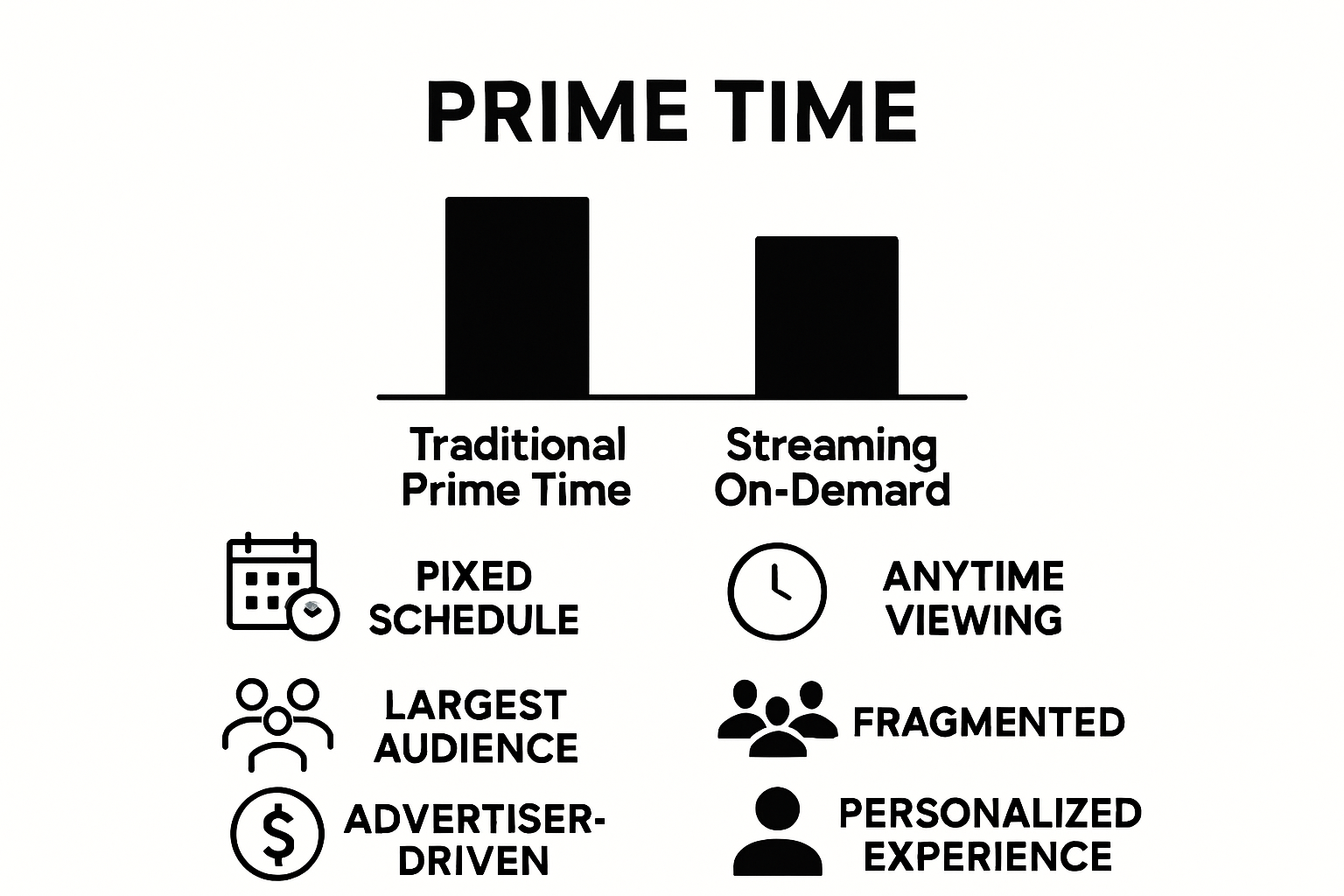 While traditional prime time remains relevant, it is increasingly sharing space with a more dynamic, user controlled viewing ecosystem that prioritizes individual preference over collective scheduling.
Key Trends Shaping the Future of Prime Time
The television landscape is undergoing unprecedented transformation, driven by technological innovation and shifting audience expectations. The Future of TV provides critical insights into the emerging paradigms that will redefine how we consume entertainment.
Technological Disruption and Content Delivery
According to research from the NAB Show, emerging technologies are fundamentally restructuring media consumption. Artificial intelligence and advanced streaming technologies are creating more personalized, responsive viewing experiences that challenge traditional prime time models. These technologies enable real time content adaptation, allowing platforms to dynamically adjust programming based on immediate audience engagement and preferences.
Evolving Audience Interaction Models
Modern entertainment consumption is becoming increasingly interactive and personalized. Key transformative trends include:
- AI driven content recommendations
- Interactive storytelling formats
- Personalized viewing experiences
- Multi platform content integration
Viewers are no longer passive consumers but active participants in their entertainment ecosystem. The boundaries between traditional broadcasting, streaming, and interactive media are rapidly dissolving, creating a more dynamic and responsive content landscape.
The future of prime time is not about fixed schedules but about creating flexible, adaptive content experiences that meet individual viewer preferences. As technology continues to evolve, we can expect even more radical transformations in how entertainment is created, distributed, and consumed across multiple platforms and devices.
Never Miss a Moment of Prime Time—Stay Ahead with Sparetimetv.com
Are you frustrated by confusing TV schedules and unpredictable prime time changes? If you want to make sense of shifting prime time viewing and the real-time impact of streaming platforms, you need a reliable resource to help you keep up. At Sparetimetv.com, we help TV enthusiasts stay informed and in control. From detailed primetime schedules to streaming premiere updates and curated trending lists, we deliver the latest information directly to you. No more guessing when your favorite show airs or which platform will have the next big release.
Ready to take command of your entertainment choices? Explore Sparetimetv.com now for up-to-date TV guides, movie schedules, and real-time ratings that let you plan your evenings without the stress. Discover the smarter way to keep up with television today, so you never have to miss out again.
Frequently Asked Questions
What is prime time in television?
Prime time refers to the block of evening hours, typically between 8:00 PM and 11:00 PM, when television networks broadcast their most popular and valuable content to reach the largest audience.
How did prime time television originate?
Prime time originated in the 1950s as television became a central family entertainment medium. The period was recognized as an invaluable marketing opportunity for advertisers, leading to strategic programming designed to attract viewers.
Why is prime time programming important for advertisers?
Prime time programming is crucial for advertisers because it delivers massive, engaged audiences, allowing them to maximize their marketing effectiveness and target specific demographic groups with their advertisements.
How have streaming services impacted traditional prime time viewing?
Streaming services have fundamentally disrupted traditional prime time viewing by allowing audiences to watch content on-demand, eliminating the need for viewers to adhere to fixed broadcast schedules. This shift challenges the established prime time model and emphasizes personalized viewing experiences.