
Table of Contents
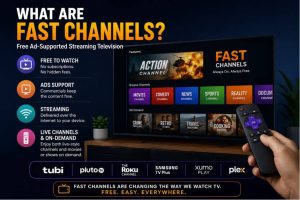
What Are FAST Channels?
If you’ve bought a new smart TV recently or opened apps like Tubi, Pluto TV, or The Roku Channel, you’ve probably come across something called a FAST channel.
Unlike Netflix or Disney+, you don’t pay a monthly subscription. Instead, you watch TV for free with commercial breaks, much like traditional broadcast television.
FAST channels have quickly become one of the fastest-growing parts of the television industry. What began as a way to watch classic TV shows has evolved into a major distribution platform featuring movies, live news, sports, reality shows, documentaries, and even exclusive original programming.
Today, virtually every major media company has a FAST strategy, making these services an increasingly important part of how people discover and watch television. Industry data also shows FAST is no longer a niche product but a growing pillar of the ad-supported TV ecosystem alongside broadcast, cable, and subscription streaming with ads.
What Does FAST Stand For?
FAST means:
Free Ad-Supported Streaming Television
Each word matters.
- Free – No monthly subscription.
- Ad-Supported – Advertising pays for the programming.
- Streaming – Programs are delivered over the internet instead of cable or an antenna.
- Television – Viewers experience scheduled channels or curated on-demand libraries designed to feel familiar to traditional TV.
Think of FAST as bringing the simplicity of channel surfing into the streaming era.
FAST Is Not “Free Netflix”
One of the biggest misconceptions is that FAST services are simply free versions of Netflix.
They’re not.
Netflix focuses primarily on on-demand viewing. FAST platforms combine two experiences:
- Traditional linear channels that run on a schedule.
- On-demand libraries that let viewers choose what to watch.
Many viewers use both during the same session. They may browse channels for background viewing before switching to an on-demand movie or series.
That hybrid approach is one reason FAST has grown so quickly.
Why FAST Channels Have Become So Popular
The growth of FAST isn’t just about saving money.
It’s about reducing friction.
Over the past decade, streaming became increasingly fragmented. A household might subscribe to several services just to keep up with favorite shows.
FAST services solve a different problem:
Instead of asking, “What should I watch?” they often answer, “Here’s something already playing.”
That familiar television experience appeals to viewers who don’t always want to spend time choosing from thousands of titles.
Recent industry data also shows that FAST attracts audiences beyond traditional cord-cutters, with advertisers increasingly treating FAST, broadcast, and cable as complementary rather than competing platforms.
How FAST Channels Work
Unlike broadcast television, FAST channels don’t transmit signals over the air.
Instead:
- Content is stored on streaming servers.
- Programs are arranged into continuous channels.
- Advertising is inserted dynamically.
- Viewers stream everything over an internet connection.
From the viewer’s perspective, it feels very similar to traditional television.
The Different Types of FAST Channels
FAST programming has expanded far beyond old reruns.
Single-Series Channels
Entire channels dedicated to one show.
Examples include channels built around long-running franchises or classic sitcoms.
Genre Channels
Focused on one category such as:
- Crime
- Comedy
- Reality
- Westerns
- Horror
- Science fiction
- Movie Channels
- Continuous movies with commercial breaks.
- News Channels
- National news
- Local news
- Weather
- Financial news
- International news
- Sports Channels
Sports have become one of FAST’s fastest-growing categories.
You’ll find:
- Highlights
- Classic games
- Original sports programming
- League content
- Analysis shows
Sports, reality, and news are among the largest FAST genres, reflecting how the market has evolved beyond libraries of older scripted series.
How FAST Channels Make Money
The business model is surprisingly straightforward.
Instead of charging viewers:
Advertisers pay for access to the audience.
Revenue comes from:
- Video commercials
- Sponsored programming
- Interactive advertising
- Brand integrations
Modern advertising technology also allows platforms to show different commercials to different households during the same program.
Why Studios Love FAST
FAST gives studios another way to monetize existing libraries.
Rather than leaving older series unused, companies can create dedicated channels around them.
That extends the commercial life of television programs while introducing them to new audiences.
It also creates additional advertising inventory without producing an entirely new service.
The Biggest FAST Platforms
Some of the largest services include:
- Tubi
- Pluto TV
- The Roku Channel
- Samsung TV Plus
- Xumo Play
- LG Channels
- Sling Freestream
- Plex
Each platform has its own mix of:
- Live-style channels
- Movies
- TV shows
- News
- Sports
- Originals
- FAST vs Broadcast TV
Broadcast TV:
Requires an antenna or cable provider.
Local affiliates.
Scheduled programming.
FAST:
Internet only.
National availability.
Hundreds of specialized channels.
Free.
FAST vs Cable
Cable:
Monthly subscription.
Large channel bundles.
FAST:
No subscription.
Advertising-supported.
Usually available instantly.
FAST vs Subscription Streaming
Subscription services emphasize:
Exclusive originals
On-demand viewing
Premium experiences
FAST emphasizes:
Free access
Continuous channels
Discovery
Familiar television viewing
Rather than replacing subscriptions, many households now use FAST alongside paid streaming services.
Are FAST Channels Really Free?
Yes.
You don’t pay a subscription fee.
The trade-off is advertising.
In many cases, viewers find the commercial load acceptable because it eliminates another monthly bill.
Why FAST Is Changing Television
One of the biggest changes isn’t technological.
It’s behavioral.
Streaming originally promised complete control over what to watch and when.
FAST recognizes that many viewers still enjoy curated programming.
Sometimes it’s easier to let someone else choose.
That balance between convenience and choice has helped FAST carve out its own place in today’s television landscape.
The Future of FAST
FAST is no longer viewed as a side business.
Major entertainment companies are expanding free, ad-supported offerings, and even subscription-focused services are exploring free entry points to reach larger audiences. At the same time, advertisers increasingly plan campaigns across broadcast, cable, FAST, and other streaming environments as one connected ecosystem.
Looking ahead, expect to see:
- More live sports
- More local news
- More original programming
- Better recommendations
- Improved personalization
- More exclusive channels built around popular TV franchises
FAST isn’t replacing broadcast television or subscription streaming. Instead, it’s becoming a third major way people watch television.
Why This Matters for TV Viewers
A decade ago, streaming largely meant paying for another subscription.
Today, viewers have more choices.
FAST channels offer a middle ground between traditional television and subscription streaming by combining familiar channel surfing with internet delivery and no monthly fee.
For many households, they’re no longer just a backup option—they’re part of everyday viewing.
Frequently Asked Questions
What is a FAST channel?
A FAST channel is a Free Ad-Supported Streaming Television channel delivered over the internet instead of cable or an antenna.
Do I need a subscription?
No. FAST channels are free to watch.
Why are there commercials?
Advertising pays for the programming, allowing viewers to watch without a monthly subscription.
Are FAST channels live?
Most operate as scheduled, always-on channels that simulate live television, although many platforms also offer on-demand content.
What’s the difference between FAST and Netflix?
Netflix primarily offers subscription-based, on-demand viewing. FAST services focus on free viewing supported by advertising and often include continuously programmed channels.
Can I watch FAST channels on any TV?
Most modern smart TVs, streaming devices, smartphones, tablets, and web browsers support one or more FAST services.
This topic is part of our guide explaining how television scheduling, economics, and production decisions work.
See the full overview in How TV Works.