
What are Upfronts? Understanding the TV Advertising Showcase
Upfronts are where television networks try to lock in the biggest advertising deals of the year, shaping what viewers will see on their screens. You might think these glitzy events are a relic from TV’s golden age, but that’s not even close. A staggering 70 to 80 percent of all broadcast network TV ads get sold during these two weeks alone. What’s wild is how upfronts have turned into high-stakes, data-driven negotiations that shape both your favorite shows and the commercials you see, all before a single episode airs.
Table of Contents
- Defining Upfronts: A Key Event In TV Advertising
- The Importance Of Upfronts: Impact On The Industry
- How Upfronts Work: The Process And Stakeholders Involved
- Key Concepts In Upfronts: Terminology And Trends
- The Future Of Upfronts: Evolving Landscape In Entertainment
Quick Summary
| Takeaway | Explanation |
|---|---|
| Upfronts are vital for ad commitments | Upfronts secure 70-80% of broadcast advertising inventory, significantly impacting networks’ finances and programming. |
| Advertisers gain early access to premium slots | By negotiating during upfronts, advertisers can secure better rates and desired time slots before prices increase. |
| Networks assess audience interest through upfronts | Feedback and commitments help networks determine which shows to renew or cancel based on potential engagement. |
| Digital transformation reshapes upfronts | Upfronts are evolving to include digital platforms and data-driven strategies, reflecting modern viewing habits. |
| Stakeholders play distinct roles in upfront negotiations | Key players like network executives and advertisers collaborate to influence advertising strategies and programming decisions. |
Defining Upfronts: A Key Event in TV Advertising
Upfronts represent a pivotal annual event in the television advertising landscape, where major networks showcase their upcoming programming and media buyers commit to significant advertising purchases. According to NPR, this unique marketplace allows broadcast networks to finalize decisions on existing shows, unveil upcoming season schedules, and pitch new programming to potential advertisers.
The Advertising Marketplace
At its core, upfronts are a strategic negotiation platform where television networks present their fall lineup to advertising agencies and potential brand sponsors. During this concentrated two-week period, networks aim to secure substantial advertising commitments for the upcoming television season. Research from Columbia Business School reveals that an impressive 70-80% of broadcast network TV advertising inventory is sold during these critical negotiations.
Historical Context and Evolution
The upfronts market has deep roots in television history, originating in 1960 when major networks established this unique advertising approach. Traditionally, these events were elaborate presentations where network executives would invite advertisers to glamorous venues, often in New York City, to preview upcoming shows and convince them to purchase advertising slots.
Key aspects of upfronts include:
- Presenting new television series pilots
- Announcing renewal or cancellation of existing shows
- Negotiating advertising rates and prime time slots
- Providing first looks at potential breakthrough programming
Modern upfronts have evolved with the media landscape, incorporating digital platforms and streaming considerations. While still maintaining their core purpose, these events now reflect the complex, multi-platform nature of contemporary television advertising. If you want to read more about network television dynamics, our comprehensive guide offers deeper insights into this fascinating industry.
The Importance of Upfronts: Impact on the Industry
Upfronts are far more than just an annual advertising event. They represent a critical strategic mechanism that fundamentally shapes television programming, advertising investments, and network decision making. Research from ResearchGate highlights how these events facilitate long-term planning and partnership between networks and advertisers, influencing content investment and innovation strategies.
Financial Implications and Risk Management
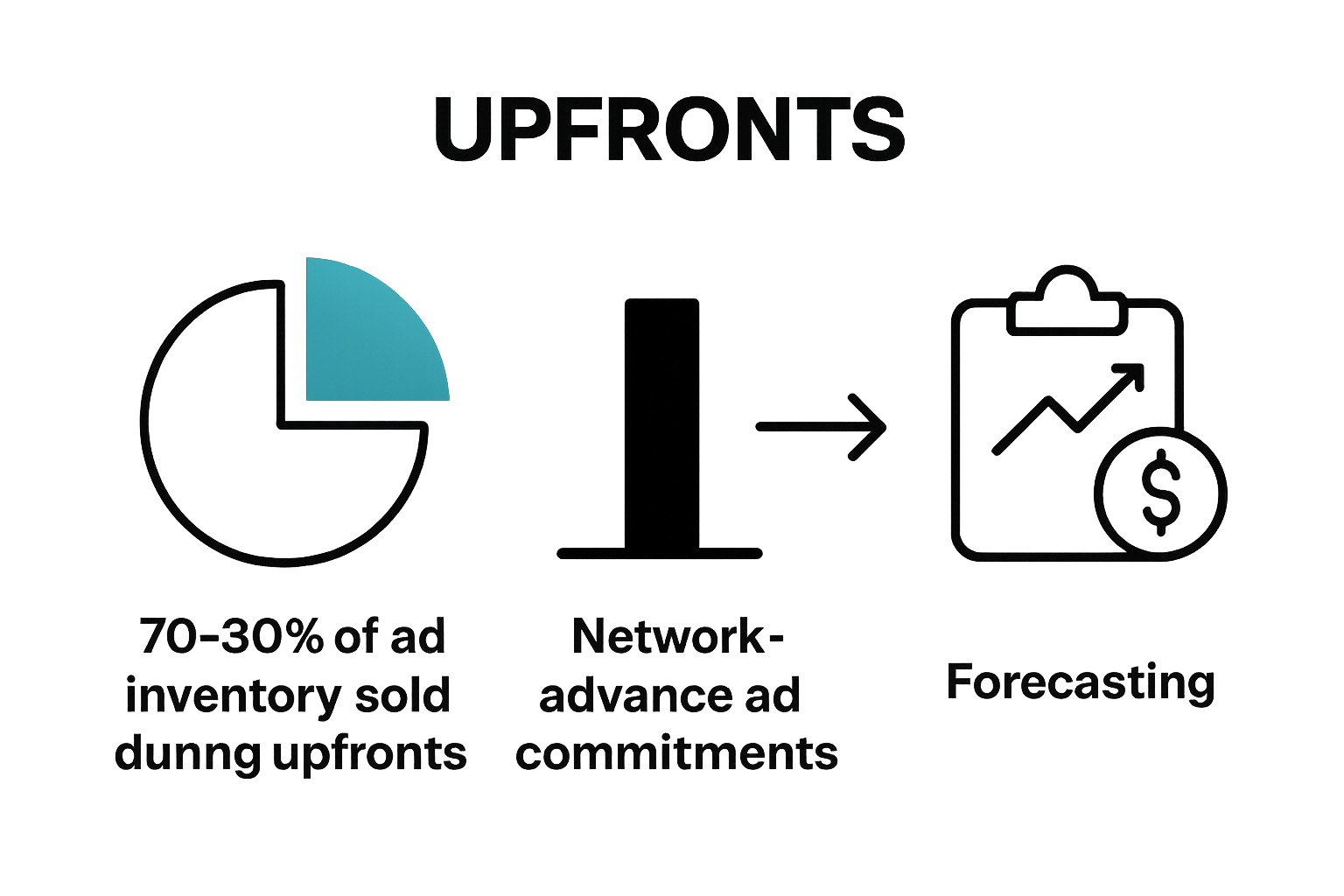
For television networks, upfronts serve as a crucial financial forecasting tool. By securing advertising commitments months in advance, networks can manage financial risks and make informed decisions about program production. The concentrated period allows networks to gauge advertiser interest, adjust programming strategies, and allocate resources more effectively. Advertisers benefit by obtaining preferential rates and securing prime advertising slots before the competitive market drives prices higher.
Programming and Content Development
Upfronts play a pivotal role in determining which television shows receive continued investment. Networks use these events to test market reception for new TV pilots, assess potential audience engagement, and make critical decisions about show renewals. The feedback and financial commitments received during upfronts directly influence which programs move forward and receive substantial production budgets.
Key strategic considerations during upfronts include:
- Evaluating audience demographics and potential viewership
- Assessing advertising revenue potential for new and existing shows
- Determining production budgets based on preliminary market interest
- Identifying potential breakthrough programming concepts
Modern upfronts have transformed from traditional presentation models into complex negotiation platforms that reflect the dynamic nature of media consumption. They now incorporate digital platforms, streaming considerations, and multi-channel advertising strategies, ensuring networks remain adaptable in an increasingly fragmented media landscape.
How Upfronts Work: The Process and Stakeholders Involved
The upfronts process involves a complex interaction between multiple industry stakeholders, each playing a critical role in this annual television advertising marketplace. According to the Hollywood Radio and Television Society, the event represents a unique intersection of creative vision and commercial strategy, where networks, advertisers, and media buyers converge to shape the upcoming television season.
Key Players and Their Roles
Multiple stakeholders contribute to the upfronts ecosystem, each with distinct objectives and strategic priorities. Television networks present their programming lineup, showcasing new season premieres and potential breakthrough shows. Advertising agencies and media buying firms evaluate these presentations, assessing audience potential and alignment with brand marketing strategies. Crucial decision makers include network executives, advertising agency representatives, media buyers, and brand marketing strategists.
Negotiation and Commitment Dynamics
The upfronts process is fundamentally a sophisticated negotiation platform where advertising inventory is traded. Networks aim to secure maximum advertising commitments, while advertisers seek optimal placement and audience reach. The negotiations typically involve complex discussions about:
- Pricing structures for different time slots
- Target demographic alignments
- Potential audience engagement metrics
- Cross platform advertising opportunities
Advertisers carefully analyze proposed programming, considering factors like viewership demographics, show popularity, and potential brand alignment. Networks, in turn, use these negotiations to validate program concepts, secure funding for new shows, and make critical decisions about continuing or canceling existing series. The entire process represents a delicate balance between creative content and commercial viability, where each presentation and discussion can significantly impact the television landscape for the upcoming season.
Key Concepts in Upfronts: Terminology and Trends
Understanding the complex world of upfronts requires familiarity with specific terminology and emerging industry trends. According to Wikipedia, an upfront is a strategic gathering where television network executives meet with advertisers to sell commercial airtime months before the television season begins.
Critical Terminology in Upfront Negotiations
The upfront marketplace is rich with specialized language that reflects its unique commercial ecosystem. Key terms include “inventory” (available advertising slots), “scatter market” (last minute ad purchasing), and “guaranteed impressions” (promised audience reach). Networks and advertisers engage in intricate negotiations using these concepts, determining the financial and strategic landscape of television advertising for the upcoming season. Understanding these terms is crucial for comprehending the future of TV advertising dynamics.
To help clarify the often complex terminology used in upfront negotiations, the table below defines key terms that appear throughout the process.
| Term | Definition |
|---|---|
| Upfronts | Annual events where TV networks sell major portions of advertising inventory in advance. |
| Inventory | The available advertising slots that networks offer for purchase to advertisers. |
| Scatter Market | The market for buying TV ads at the last minute, outside the upfronts. |
| Guaranteed Impressions | Promised audience reach that networks commit to delivering for advertiser purchases. |
| Media Buyer | Agency or individual responsible for purchasing advertising time on behalf of brands. |
| Network Executive | Senior network staff overseeing programming, scheduling, and ad negotiation decisions. |
| Prime Time Slot | The most sought-after and expensive period for ads, typically during peak viewing hours. |
Emerging Trends in Upfront Negotiations
Modern upfronts are experiencing significant transformations driven by technological and viewer consumption changes. The traditional model is evolving to incorporate digital platforms, streaming services, and more sophisticated audience targeting mechanisms. Contemporary upfront trends demonstrate a shift towards:
- Multiplatform advertising strategies
- Increased data driven decision making
- Greater emphasis on targeted demographic reach
- Integration of digital and traditional television advertising
These trends reflect the complex media landscape where traditional network television coexists with streaming platforms, requiring more nuanced and flexible advertising approaches.
The following table compares traditional and modern upfront approaches, illustrating how the evolution of television and media has changed the landscape for advertisers and networks alike.
| Aspect | Traditional Upfronts | Modern Upfronts |
|---|---|---|
| Event Format | In-person presentations, glamor focus | Hybrid events, digital integration |
| Main Platforms | Broadcast and cable TV | Includes streaming and digital platforms |
| Advertising Strategy | General audience focus | Data-driven and targeted ads |
| Inventory Sold | Mostly TV ad slots | TV plus digital/streaming ad slots |
| Audience Measurement | Nielsen ratings | Real-time, multi-platform analytics |
| Decision Timeline | Annual, set schedules | Continuous, flexible negotiations |
| Key Stakeholders | Networks, agencies, brands | Networks, agencies, brands, tech partners |
The Future of Upfronts: Evolving Landscape in Entertainment
The television advertising landscape is undergoing a transformative shift, with upfronts adapting to meet the demands of an increasingly fragmented media ecosystem. According to Columbia University’s Business Magazine, the media and entertainment sector is experiencing rapid technological innovations that are fundamentally reshaping traditional advertising models.
Digital Transformation and Streaming Impact
Traditional upfront models are being reimagined as streaming platforms and over-the-top (OTT) media services challenge conventional television advertising strategies. Emerging digital platforms are creating new opportunities for targeted advertising, moving beyond the traditional network television approach. Network TV is no longer the sole domain of advertising, with digital platforms offering more granular audience targeting and measurement capabilities.
Technological Innovations in Advertising Strategies
The future of upfronts will likely be characterized by more sophisticated, data-driven approaches to media buying. Advertisers and networks are increasingly leveraging advanced technologies to create more personalized and effective advertising experiences. Key developments include:
- Artificial intelligence driven audience segmentation
- Real-time advertising performance tracking
- Cross platform measurement capabilities
- Personalized content and advertising recommendations
These technological innovations suggest a future where upfronts become more dynamic, flexible, and responsive to changing viewer consumption patterns. The traditional week-long presentation model is evolving into a continuous, data-driven negotiation process that spans multiple platforms and content delivery methods.
Stay Ahead in TV Advertising with Real-Time TV Guides
Are you overwhelmed by the complexity of upfront negotiations and ever-changing programming schedules? After exploring the essentials of upfronts, from prime slot negotiations to identifying breakthrough series, you know how high the stakes are. Missing a season premiere or struggling to track upcoming network shows can leave even experienced professionals out of sync with key advertising opportunities.

Turn insider knowledge into action with Sparetimetv.com. Use our up-to-date season premiere guide and detailed insights into network TV to plan your schedule with confidence. Visit our main site today for accurate TV listings, curated recommendations, and features designed for TV industry pros and passionate fans alike. Take control of your ad strategy before your competition makes the next move.
Frequently Asked Questions
What are upfronts in television advertising?
Upfronts are annual events where major television networks showcase their upcoming programming to advertising agencies and buyers. During this time, advertisers commit to purchasing significant advertising slots ahead of the new television season.
How do upfronts influence television programming decisions?
Upfronts play a critical role in determining which shows receive investment and continuation. Networks evaluate audience feedback and financial commitments received during upfronts to make decisions on show renewals and budget allocations for new programs.
What are the financial implications of upfronts for networks and advertisers?
For networks, upfronts serve as a financial forecasting tool, allowing them to secure advertising commitments and manage production costs effectively. Advertisers benefit by obtaining favorable rates and securing prime advertising slots before competition drives prices up.
How have upfronts evolved with the rise of digital and streaming platforms?
Modern upfronts have transformed to reflect the complex media landscape, incorporating digital platforms and streaming considerations. This evolution includes multiplatform advertising strategies, data-driven decision making, and an increased emphasis on targeted demographic reach.