
What is a Miniseries? Understanding Its Role in TV
Miniseries are taking over streaming platforms and changing how people binge-watch stories. Most miniseries wrap up their entire story in just two to ten episodes, squeezing complex plots into a surprisingly short run. Think that sounds restrictive. It is actually what gives miniseries their edge, letting creators deliver sharper, tightly focused stories that grab your attention and refuse to let go.
Table of Contents
- Defining A Miniseries: Key Characteristics
- The Significance Of Miniseries In Entertainment
- How Miniseries Differ From Other Formats
- Popular Examples And Their Impact
- The Future Of Miniseries In Streaming
Quick Summary
| Takeaway | Explanation |
|---|---|
| Miniseries have limited episode counts | Typically containing two to ten episodes, miniseries allow for concise storytelling without narrative sprawl. |
| Miniseries excel in complex storytelling | They effectively adapt intricate literary works and explore detailed historical or biographical narratives. |
| Production advantages attract top talent | Miniseries enable creators to secure high-profile actors and writers with shorter commitments, enhancing narrative quality. |
| Streaming boosts miniseries popularity | Platforms like Netflix favor miniseries for their ability to deliver complete narratives quickly, engaging modern audiences effectively. |
| Global narratives find new platforms | The miniseries format allows for international storytelling, democratizing diverse cultural voices in the entertainment industry. |
Defining a Miniseries: Key Characteristics
A miniseries represents a unique storytelling format in television that distinguishes itself through specific narrative and structural characteristics. Unlike traditional television series that might run for multiple seasons, a miniseries is designed to tell a complete story within a predetermined and limited number of episodes.
Narrative Structure and Length
The core defining feature of a miniseries is its intentionally compact storytelling approach. Typically, miniseries range from two to ten episodes, with most falling between four to six episodes. This limited episode count allows creators to craft a tightly focused narrative without the potential narrative sprawl that can occur in longer-running shows.
According to Britannica, a miniseries is a “limited-run television series that tells a story in a predetermined, limited number of episodes.” This definition underscores the intentional and strategic nature of the format, where every episode serves a specific narrative purpose.
Comprehensive Storytelling in Compact Format
Miniseries excel at delivering complex, nuanced stories that might not sustain a multi-season narrative. They are particularly effective for:
- Adapting literary works with intricate plots
- Exploring historical events or biographical stories
- Presenting complex character studies
- Delivering high-concept narratives with specific dramatic arcs
The condensed format allows writers and directors to maintain narrative intensity and focus, ensuring that each episode contributes significantly to the overall story. This approach differs from traditional television series, which might introduce more episodic subplots or extended character developments.
The miniseries format has gained significant popularity with the rise of streaming platforms, which provide an ideal distribution model for these concentrated storytelling experiences. By offering a complete narrative arc within a short timeframe, miniseries provide viewers with a satisfying and immersive entertainment experience that can be consumed quickly and comprehensively.
The Significance of Miniseries in Entertainment
Miniseries have emerged as a powerful storytelling medium that bridges the gap between traditional television series and cinematic narratives. Their unique format offers unprecedented creative opportunities for storytellers, actors, and networks to explore complex narratives with greater depth and precision.
Creative Freedom and Artistic Expression
The limited episode structure of miniseries provides creators with exceptional artistic latitude. Unlike long-running series that might compromise narrative integrity to extend storylines, miniseries allow writers and directors to craft tightly scripted, focused stories that maintain dramatic tension from beginning to end.
Production teams can attract high-caliber talent who might be hesitant to commit to multi-season projects. Acclaimed actors, directors, and writers see miniseries as platforms for telling nuanced stories without the long-term commitment of traditional television series. This approach has led to critically acclaimed productions that push creative boundaries.
Economic and Strategic Advantages
From a production perspective, miniseries represent a strategic investment for networks and streaming platforms. The controlled production scope allows for:
- More predictable budget management
- Lower financial risk compared to multi-season series
- Ability to attract premium talent
- Flexible programming options
Streaming platforms have particularly embraced this format, recognizing its appeal to audiences seeking immersive yet concise storytelling experiences. Find out more about standout TV formats that are reshaping entertainment consumption.
The miniseries format also enables global storytelling, allowing international narratives to reach wider audiences without the pressure of sustaining multiple seasons. This approach has democratized storytelling, giving voice to diverse cultural experiences that might otherwise struggle to find representation in traditional television formats.
Ultimately, miniseries represent more than just a television format.
The following table summarizes the major advantages of miniseries in entertainment as highlighted in the article, focusing on their creative, economic, and global storytelling strengths.
| Advantage | Explanation |
|---|---|
| Creative Freedom | Allows tightly scripted, focused narratives and high artistic quality |
| Attracts High-Profile Talent | Shorter commitments appeal to acclaimed actors, writers, directors |
| Budget and Risk Control | More predictable budgets and lower financial risk |
| Programming Flexibility | Adaptable for networks and streaming platforms |
| Enables Global and Diverse Storytelling | Supports international narratives and elevates underrepresented voices |
| They are a sophisticated storytelling approach that reflects the evolving preferences of modern audiences who value quality, efficiency, and narrative completeness in their entertainment experiences. |
How Miniseries Differ from Other Formats
Television storytelling encompasses various formats, each with unique structural characteristics. Miniseries occupy a distinctive position, setting themselves apart through narrative approach, production strategy, and audience engagement methods that fundamentally distinguish them from traditional television series.
Narrative Continuity and Structure
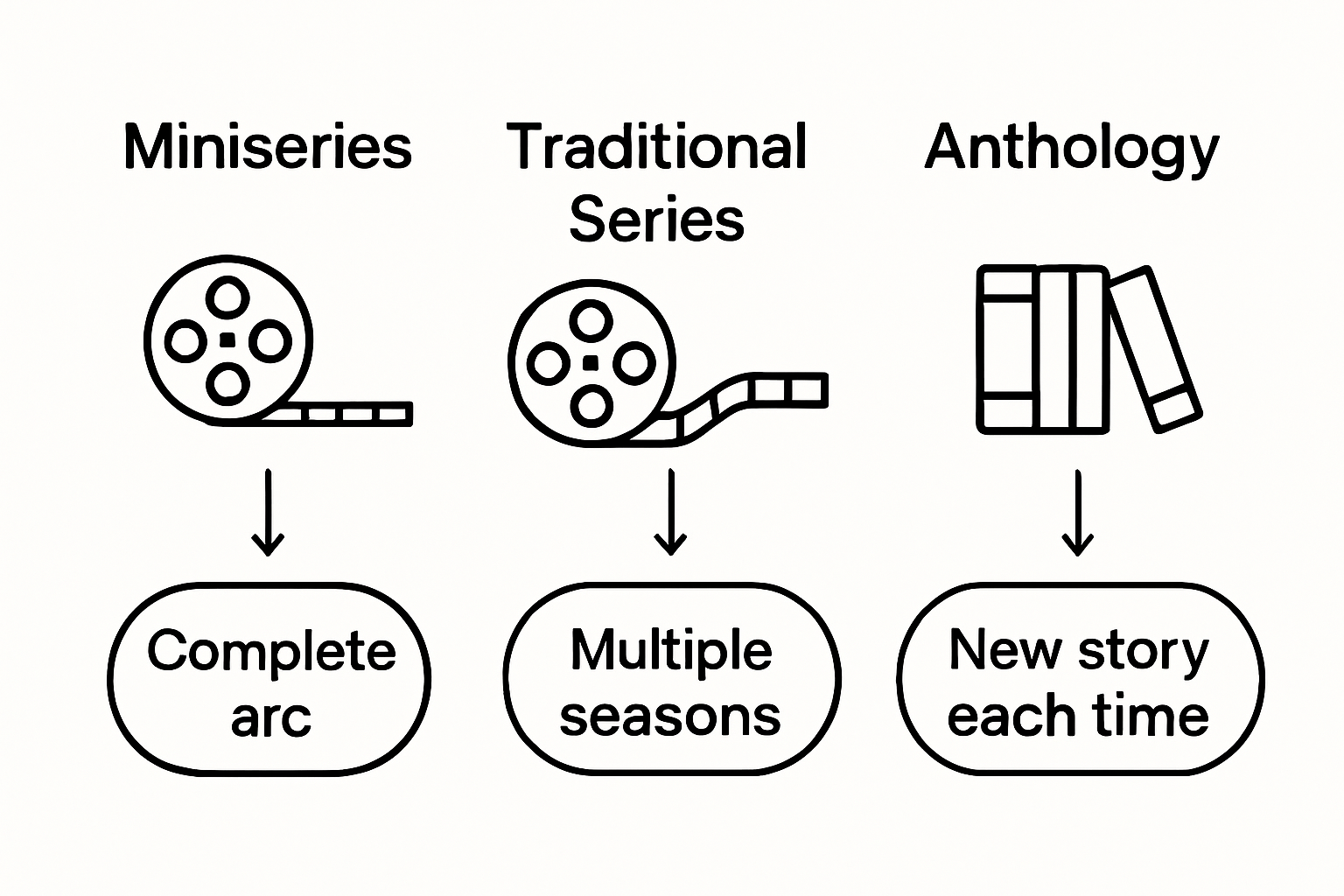
Unlike ongoing television series that may extend storylines indefinitely, miniseries present a predetermined narrative arc with a clear beginning, middle, and definitive end. Where traditional series might introduce open-ended plot developments to sustain viewer interest across multiple seasons, miniseries commit to resolving their central dramatic questions within a compact timeframe.
This structural approach allows for more concentrated storytelling, eliminating the narrative padding that can dilute storytelling quality in longer-running shows.
To clarify the distinctions between miniseries and other television formats, the following table compares key aspects discussed in the article.
| Format | Structure | Episode Count | Narrative Arc | Talent Commitment |
|---|---|---|---|---|
| Miniseries | Single, continuous story | 2-10 (usually 4-6) | Defined beginning, end | Short-term, attracts top talent |
| Traditional Series | Multiple seasons, may have episodic plots | Dozens+ | Open-ended or ongoing | Long-term |
| Anthology Series | Different stories each season or episode | Varies | Resets each season/ep. | Varies, often rotating |
 Each episode in a miniseries serves a precise narrative function, maintaining dramatic momentum and preventing storyline meandering.
Production and Commitment Differences
The production model for miniseries radically differs from standard television formats. Key distinguishing features include:
- Single narrative trajectory without potential season renewals
- Ability to attract high-profile talent for short-term commitments
- More film-like production values and budget allocations
- Greater creative control for writers and directors
Explore more about unique TV storytelling formats that challenge traditional television conventions.
Streaming platforms have particularly accelerated the miniseries trend, recognizing audience preferences for concise, high-quality storytelling. The format allows for international collaborations, global narratives, and nuanced storytelling that might not sustain multiple seasons.
Compared to anthology series, which reset narratives completely between episodes, miniseries maintain a continuous storyline.
 Compared to traditional series, they offer a more concentrated narrative experience that respects audience time and engagement, delivering complete stories without prolonged narrative commitments.
Popular Examples and Their Impact
Miniseries have transformed television storytelling, with certain productions leaving an indelible mark on popular culture and the entertainment landscape. These landmark series demonstrate the profound narrative potential of the format, showcasing how concentrated storytelling can captivate global audiences.
Historical and Biographical Narratives
Landmark miniseries have often centered on historical events or biographical stories, providing nuanced explorations of complex human experiences. Productions like HBO’s ‘Chernobyl’ and ‘Band of Brothers’ exemplify how miniseries can offer deep, immersive narratives that traditional documentary or episodic formats cannot achieve.
According to research from television studies, these productions do more than entertain. They educate audiences, spark conversations about significant historical moments, and provide unprecedented insights into pivotal human experiences.
Genre-Defining Storytelling
Certain miniseries have revolutionized audience expectations across multiple genres. Notable examples include:
- ‘True Detective’ (Season 1): Redefining crime drama storytelling
- ‘The Queen’s Gambit’: Transforming perspectives on competitive sports narratives
- ‘Watchmen’: Reimagining superhero storytelling through complex social commentary
- ‘Sharp Objects’: Pioneering psychological thriller approaches
These productions demonstrate how miniseries can deliver cinematic quality storytelling within a television format, attracting top-tier talent and pushing creative boundaries.
Moreover, streaming platforms have accelerated the miniseries revolution, providing global distribution channels that enable diverse stories to reach international audiences. The format allows creators to tackle complex narratives without the pressure of sustaining multiple seasons, resulting in more focused, impactful storytelling that resonates deeply with viewers.
The Future of Miniseries in Streaming
Streaming platforms are fundamentally reshaping television storytelling, with miniseries emerging as a critical format for engaging contemporary audiences. The evolving media landscape presents unprecedented opportunities for concentrated, high-quality narrative experiences that transcend traditional television boundaries.
Technological and Audience Transformation
The streaming revolution has democratized content consumption, allowing viewers unprecedented control over their entertainment experiences. Miniseries perfectly align with this shift, offering complete narratives that can be consumed quickly and intensely. Platforms like Netflix, Hulu, and Amazon Prime are investing heavily in original miniseries content, recognizing their potential to attract and retain subscribers.
According to research on streaming media, these platforms are strategically positioning miniseries as key differentiators in an increasingly competitive market.
Global Storytelling and Diversity
Miniseries are becoming powerful vehicles for diverse, international narratives. The format offers unique advantages for global storytelling:
- Reduced production commitments for international talent
- Lower financial risks for experimental narratives
- Opportunities for cross-cultural storytelling
- Platforms for underrepresented voices and perspectives
Explore trending TV show formats that are transforming entertainment consumption.
The rise of streaming has also enabled more niche, specialized content. Creators can now develop miniseries targeting specific audience segments, exploring complex themes that might not sustain traditional multi-season series. This trend suggests a future where storytelling becomes more personalized, nuanced, and globally interconnected.
Discover Every Miniseries Worth Watching at Sparetimetv.com
Are you frustrated by missing out on groundbreaking miniseries or struggling to keep up with new releases? As the article explains, miniseries tell powerful stories in a concise format, but with so many streaming and broadcast options, it is easy to feel overwhelmed or miss premiere dates and trending titles. You want to experience complete narratives without waiting through multiple seasons, but reliable scheduling and top picks can be hard to find.

Now you can take control of your TV experience and never miss an acclaimed miniseries. Explore top-rated shows, updated schedules, and current streaming releases all in one place. Our TV guides and curated lists are built for true TV fans who value complete, focused entertainment. Visit Sparetimetv.com now and see how easy it is to find every must-see miniseries and more. Start planning your next binge with confidence and catch every story before everyone else.
Frequently Asked Questions
What defines a miniseries in television?
A miniseries is defined as a limited-run television series that tells a complete story within a predetermined number of episodes, typically ranging from two to ten episodes. This format allows for focused storytelling without the narrative sprawl often seen in longer series.
How does a miniseries differ from a traditional television series?
Unlike traditional television series that can extend indefinitely with ongoing plotlines, a miniseries has a clear beginning, middle, and end, resolving its narrative arc within a limited timeframe. This structured approach prevents storyline meandering and maintains dramatic intensity throughout.
What are some popular examples of miniseries that have impacted television?
Popular miniseries such as ‘Chernobyl,’ ‘Band of Brothers,’ ‘True Detective,’ and ‘The Queen’s Gambit’ illustrate the format’s ability to deliver immersive narratives and high-quality storytelling, often redefining genre expectations and captivating global audiences.
Why are miniseries gaining popularity with streaming platforms?
Miniseries are gaining popularity on streaming platforms due to their ability to provide concise, high-quality narratives that align with audience preferences for binge-watching. They allow creators to tell complex stories without the pressure of sustaining multiple seasons, often leading to more focused and impactful storytelling.