
TV guides sound like a throwback to the days of printed schedules and remote controls with just a handful of channels. But digital TV guides today handle a tidal wave of choices and have turned into something far more powerful. Get this, modern streaming TV guides now use artificial intelligence to make hyper-personalized recommendations, sometimes even before you know what you want to watch.
Table of Contents
- Defining A TV Guide: Understanding Its Purpose
- The Importance Of TV Guides In Modern Media Consumption
- How TV Guides Organize Content: Structure And Categories
- The Evolution Of TV Guides: From Print To Digital Platforms
- Future Trends: The Role Of TV Guides In Streaming Services
Quick Summary
| Takeaway | Explanation |
|---|---|
| TV guides simplify media navigation. | They transform complex programming into easy-to-read schedules, helping viewers find content quickly. |
| Digital TV guides are highly interactive. | Modern guides provide real-time updates, personalized recommendations, and keyword search features for efficiency. |
| Organizational strategies are key for TV guides. | Content is categorized by genre, age rating, and themes, making it easier for viewers to select shows. |
| AI enhances content recommendations. | Streaming services use machine learning to analyze viewing habits and suggest programs tailored to individual preferences. |
| TV guides reduce decision fatigue. | By streamlining options, guides help viewers manage their time and discover new shows without feeling overwhelmed. |
Defining a TV Guide: Understanding Its Purpose
A TV guide represents a comprehensive informational resource designed to help viewers navigate the complex world of television programming. At its core, a TV guide provides detailed schedules, channel listings, and program information that enables audiences to discover, track, and plan their entertainment consumption.
The Essential Function of TV Guides
TV guides serve multiple critical purposes for television consumers. They act as a centralized information hub that transforms the overwhelming landscape of multiple channels and streaming platforms into an easily digestible format. Explore current TV listings to understand how these guides simplify media consumption.
Key functions of a TV guide include:
- Program Scheduling: Displaying exact broadcast times for shows across various networks
- Channel Information: Providing channel numbers, network details, and programming categories
- Content Preview: Offering brief descriptions and ratings for upcoming shows
Technical Evolution of TV Guides
Originally printed in newspapers and magazines, TV guides have dramatically transformed with digital technology. According to the Library of Congress, electronic program guides (EPGs) now represent sophisticated software applications that display television listings in interactive digital formats.
Modern TV guides integrate advanced features like personalized recommendations, search capabilities, and real-time updates across traditional broadcast, cable, and streaming platforms. They have evolved from simple printed schedules to intelligent systems that help viewers make informed entertainment choices in an increasingly complex media landscape.
The Importance of TV Guides in Modern Media Consumption
In an era of unprecedented media diversity, TV guides have become essential navigation tools for viewers seeking meaningful entertainment experiences. They transform the complex landscape of hundreds of channels and streaming platforms into manageable, intelligible information that empowers audience choices.
Simplifying Media Complexity
Modern entertainment ecosystems are overwhelmingly complex. Viewers encounter thousands of programming options across cable, satellite, streaming, and traditional broadcast networks. Explore potential future media trends to understand how TV guides help manage this intricate media environment.
TV guides provide critical support by:
- Reducing Decision Fatigue: Helping viewers quickly identify appealing content
- Time Management: Enabling precise scheduling and planning of entertainment consumption
- Discovering New Content: Highlighting programs viewers might otherwise miss
Bridging Information and Entertainment
According to research from the National Institutes of Health, television serves as more than mere entertainment—it is a powerful communication medium that shapes cultural understanding and social perspectives. TV guides play a crucial role in this process by presenting context, ratings, and program descriptions that help viewers make informed choices.
By offering comprehensive, user-friendly information, TV guides have evolved from simple scheduling tools to intelligent platforms that curate personalized entertainment experiences. They help viewers navigate an increasingly fragmented media landscape, transforming potential overwhelm into meaningful, intentional viewing decisions.
How TV Guides Organize Content: Structure and Categories
TV guides employ sophisticated organizational strategies to transform complex media landscapes into comprehensible, user-friendly information systems. These structured approaches help viewers efficiently navigate an increasingly diverse entertainment ecosystem by categorizing and presenting content through multiple strategic frameworks.
Content Classification Methods
Modern TV guides utilize multiple classification techniques to help viewers find relevant programming. Check out our comprehensive primetime listings to see these organizational principles in action. These methods include:
- Genre Categorization: Grouping shows by type like drama, comedy, reality, documentary
- Age Ratings: Indicating appropriate viewer demographics
- Thematic Grouping: Organizing content around specific themes or audience interests
Hierarchical Content Organization
According to Library of Congress research, television content can be systematically organized into hierarchical structures that help viewers understand programming nuances. These structures typically include primary categories like educational, instructional, and entertainment programming.
The organizational approach considers multiple dimensions: broadcast time, channel platform, genre, target audience, and content complexity.
To illustrate the various ways TV guides help viewers organize and select programming, here is a table summarizing common content classification methods mentioned in the article.
| Classification Method | Description | Example |
|---|---|---|
| Genre Categorization | Groups programs by type | Drama, Comedy, Documentary, Reality |
| Age Ratings | Indicates appropriate viewing age groups | TV-G, TV-14, TV-MA |
| Thematic Grouping | Clusters content around themes or interests | “Family Night”, “Crime Series”, “Nature & Science” |
| Broadcast Time | Organizes programs by when they air | Morning, Afternoon, Primetime |
| Channel Platform | Lists what network or service offers a program | ABC, Netflix, HBO |
By creating these multifaceted classification systems, TV guides transform overwhelming media choices into navigable, comprehensible information ecosystems that empower viewer decision making.
The Evolution of TV Guides: From Print to Digital Platforms
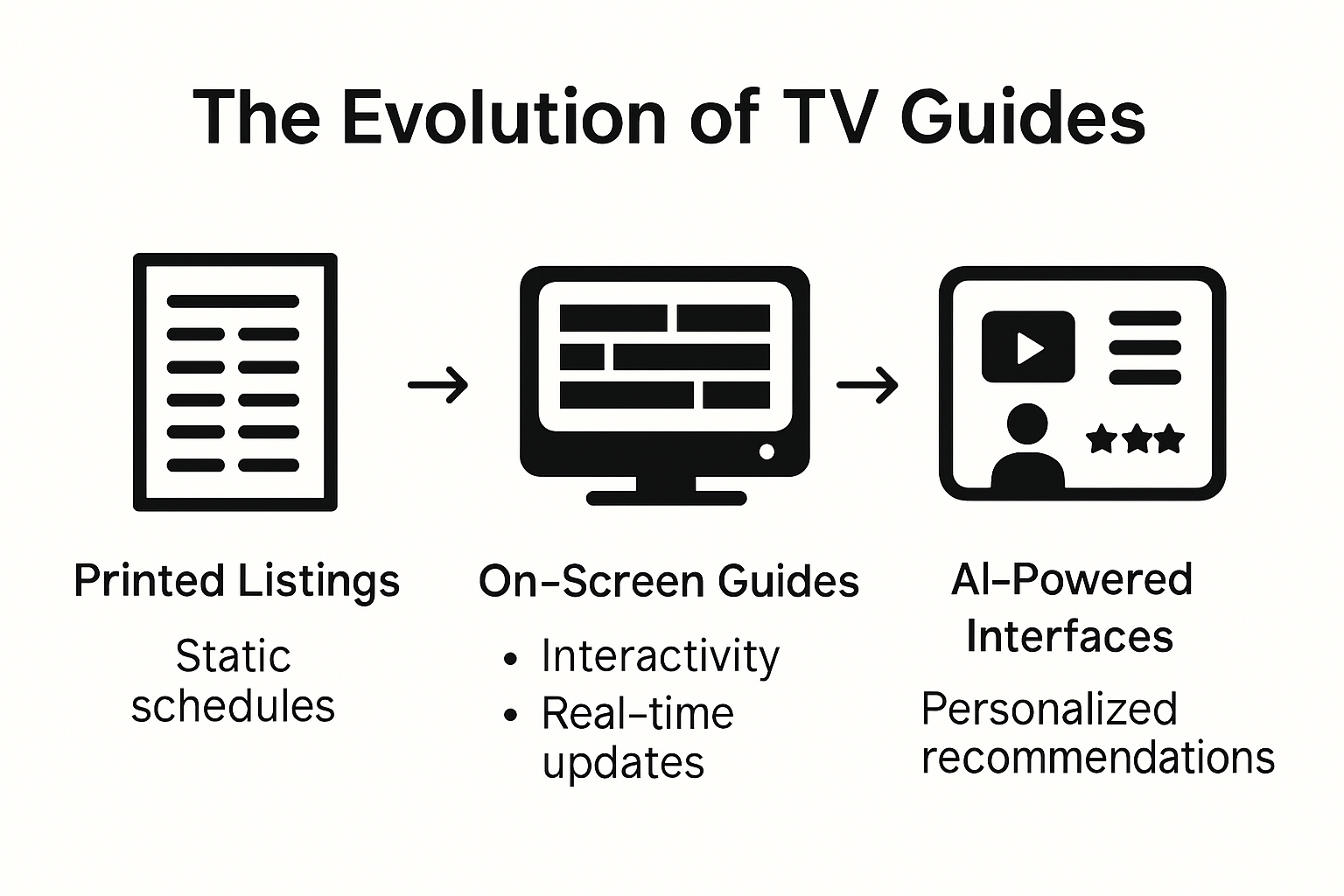
TV guides have undergone a remarkable transformation, shifting from static printed publications to dynamic, interactive digital platforms that reflect the rapid technological changes in media consumption. This evolution represents a profound adaptation to viewers’ changing needs and technological capabilities.
The Print Era: Traditional Roots
Historically, TV guides were physical magazines and newspaper supplements that provided weekly programming schedules. These printed resources were the primary method for viewers to plan their entertainment, featuring comprehensive listings, brief show descriptions, and network information. Explore potential media transformations to understand how technology has reshaped information delivery.
Key characteristics of print TV guides included:
- Fixed Information: Schedules printed in advance with limited update capabilities
- Physical Distribution: Sold in stores or delivered with newspapers
- Limited Interactivity: One way communication from publisher to reader
Digital Transformation
According to research from the Federal Communications Commission, digital platforms revolutionized TV guides by introducing real time updates, personalized recommendations, and multi platform accessibility. Electronic program guides (EPGs) emerged, integrating seamlessly with cable, satellite, and streaming services.
Modern digital TV guides offer unprecedented flexibility, allowing viewers to search, filter, and customize their viewing experience across multiple devices. This technological evolution has transformed TV guides from simple scheduling tools to intelligent, interactive platforms that anticipate and respond to individual viewer preferences.
To help clarify how TV guides have evolved over time, the following table compares key features of print and digital TV guides as described in the article.
| Feature | Print TV Guides | Digital TV Guides |
|---|---|---|
| Update Capability | Fixed, schedules printed in advance | Real-time updates; instantly reflect programming changes |
| Distribution | Physical magazines or newspapers | Accessible on multiple digital platforms/devices |
| Interactivity | None; one-way communication | Highly interactive; search, filters, and personalization |
| Content Personalization | Not available | Personalized recommendations using AI |
| Platform Coverage | Broadcast and cable channels only | Broadcast, cable, and multiple streaming services |
| Search Functionality | Limited or none | Keyword and advanced search capabilities |
Future Trends: The Role of TV Guides in Streaming Services
Streaming services have dramatically reshaped television consumption, compelling TV guides to evolve from traditional scheduling tools into sophisticated, intelligent content recommendation platforms. This transformation reflects the dynamic shift in how audiences discover, consume, and interact with entertainment media.
Personalization and Artificial Intelligence
Modern streaming TV guides leverage advanced artificial intelligence to deliver hyper-personalized content recommendations. Learn more about emerging media technologies to understand how these intelligent systems are revolutionizing viewer experiences.
Key emerging capabilities include:
- Machine Learning Algorithms: Analyzing individual viewing patterns
- Cross Platform Integration: Recommending content across multiple streaming services
- Predictive Content Suggestions: Anticipating viewer preferences before they search
Adaptive Recommendation Ecosystems
According to research from the University of Illinois, streaming platforms are developing increasingly sophisticated recommendation systems that transcend traditional linear programming models. These adaptive ecosystems consider multiple factors including viewing history, time of day, genre preferences, and even emotional states to curate personalized entertainment experiences.
Future TV guides will likely become comprehensive entertainment management platforms, offering not just recommendations but integrated viewing experiences that seamlessly blend content discovery, social interaction, and personalized entertainment curation.
Frequently Asked Questions
What is a TV guide?
A TV guide is a comprehensive resource that provides viewers with detailed schedules, channel listings, and program descriptions to help them navigate television programming.
How do TV guides simplify media consumption?
TV guides simplify media consumption by organizing vast content options into easily digestible formats, helping viewers quickly identify shows they want to watch and manage their viewing schedules.
What features do digital TV guides offer that print guides do not?
Digital TV guides offer real-time updates, personalized recommendations, advanced search capabilities, and multi-platform accessibility, which enhance the user experience compared to traditional print guides.
How have TV guides evolved with the rise of streaming services?
With the rise of streaming services, TV guides have evolved into sophisticated platforms that use artificial intelligence to provide personalized content recommendations and adaptive ecosystems, reflecting viewers’ preferences and viewing habits.