
Digital streaming now accounts for a staggering 82 percent of all consumer internet traffic worldwide, completely changing how people watch, listen, and share media. Most think streaming is just about convenience and skipping downloads, but that barely scratches the surface. The biggest shift is how this tech is smashing every old barrier, letting anyone access global content instantly and turning the entertainment world upside down.
Table of Contents
- Understanding The Concept Of Digital Streaming
- The Importance Of Digital Streaming In Entertainment
- How Digital Streaming Technology Works
- Key Components Of Digital Streaming Services
- The Future Of Digital Streaming In Media
Quick Summary
| Takeaway | Explanation |
|---|---|
| Digital streaming offers instant access to media | Users can enjoy videos and music immediately without waiting for downloads. |
| Streaming democratizes global content access | Viewers can explore diverse media from various cultures without geographical restrictions. |
| AI enhances personalized content recommendations | Streaming platforms use machine learning to suggest shows and music tailored to individual preferences. |
| Cost-effective entertainment option compared to traditional media | Subscribing to streaming services often provides a wider range of content for less money. |
| Streaming technology continuously adapts to network conditions | With protocols like HLS and DASH, video quality adjusts in real-time based on internet speed. |
Understanding the Concept of Digital Streaming
Digital streaming represents a revolutionary method of consuming media content through internet-connected devices, transforming how we access and enjoy entertainment. At its core, digital streaming enables users to watch videos, listen to music, or access other media content in real time without downloading entire files to their device.
How Digital Streaming Works
The fundamental mechanism of digital streaming involves transmitting data packets over the internet, allowing continuous media playback. When you stream content, your device receives and processes these data packets simultaneously, creating a seamless viewing or listening experience. This process differs significantly from traditional downloading, where an entire file must be transferred before consumption.
To provide a clearer understanding of how digital streaming is different from traditional downloading, the table below compares the two approaches in terms of how content is accessed and consumed.
| Aspect | Digital Streaming | Traditional Downloading |
|---|---|---|
| Content Access | Immediate playback while data downloads progressively | Requires full download before playback |
| Storage Requirement | Minimal local storage needed | Full file occupies local storage |
| Device Flexibility | Access on various internet-connected devices | Limited to the device with downloaded file |
| Buffering/Loading Time | Playback starts almost instantly | Wait until entire file downloads |
| Network Dependency | Requires continuous internet connection | Can play offline once downloaded |
Key Components of Digital Streaming:
- Content Servers: Large data centers hosting media files
- Content Delivery Networks (CDNs): Infrastructure that efficiently distributes media across global networks
- User Devices: Smartphones, smart TVs, computers, tablets capable of receiving streaming data
Technical Mechanics Behind Streaming
Streaming technology relies on advanced compression algorithms that reduce file sizes without significantly compromising quality. Protocols like HTTP Live Streaming (HLS) and Dynamic Adaptive Streaming over HTTP (DASH) enable smooth playback by adjusting video quality based on your internet connection speed.
According to Cisco’s Annual Internet Report, global internet video traffic is projected to account for 82% of all consumer internet traffic by 2022, highlighting the massive growth of digital streaming platforms.
For those interested in exploring more about evolving entertainment technologies, check out our comprehensive guide on the future of media consumption.
The Importance of Digital Streaming in Entertainment
Digital streaming has fundamentally transformed the entertainment landscape, providing unprecedented access to content and revolutionizing how audiences consume media. This technological innovation has dramatically reshaped the traditional entertainment ecosystem, offering unprecedented convenience and diversity in entertainment options.
Democratizing Content Access
Streaming platforms have democratized media consumption by breaking geographical and economic barriers. Viewers now have instant access to global content, eliminating previous limitations of broadcast television or physical media. This accessibility means that independent filmmakers, musicians, and content creators can reach worldwide audiences without traditional distribution channels.
Key Benefits of Digital Streaming:
- Unlimited content library accessible 24/7
- Personalized recommendation algorithms
- Cost effective compared to traditional media subscriptions
- Global content from diverse cultural backgrounds
Economic Impact on Entertainment Industry
The economic implications of digital streaming are profound. Traditional media companies have been compelled to adapt, creating their own streaming platforms to remain competitive. Streaming services have become major content producers, investing billions in original programming and challenging conventional Hollywood production models.
According to PwC’s Global Entertainment and Media Outlook, digital streaming revenues are projected to continue exponential growth, fundamentally restructuring entertainment economic models.
For those interested in understanding how technology continues to reshape entertainment, explore our insights on television’s evolving landscape.
How Digital Streaming Technology Works
Digital streaming technology represents a complex and sophisticated system of data transmission that enables seamless media consumption across multiple devices. By breaking down large media files into smaller data packets, streaming platforms can deliver content in real time, creating an uninterrupted viewing or listening experience.
The Streaming Data Transmission Process
Streaming fundamentally operates through a continuous data transfer mechanism where media content is sent from remote servers directly to user devices. Unlike traditional downloads, streaming allows immediate playback while simultaneously receiving subsequent data packets. This process involves multiple technical components working in synchronization to ensure smooth content delivery.
The following table highlights the primary technical components involved in digital streaming services and their main functions as described in the article.
| Component | Main Function |
|---|---|
| Content Servers | Host and store media files |
| Content Delivery Networks (CDNs) | Distribute content efficiently across global networks |
| User Devices | Receive and play streaming data |
| Compression Algorithms | Reduce file sizes with minimal quality loss |
| Adaptive Bitrate Streaming Tech | Adjust video quality based on internet speed |
| Buffer Management Systems | Ensure smooth, uninterrupted playback |
| Digital Rights Management | Protect and control media access |
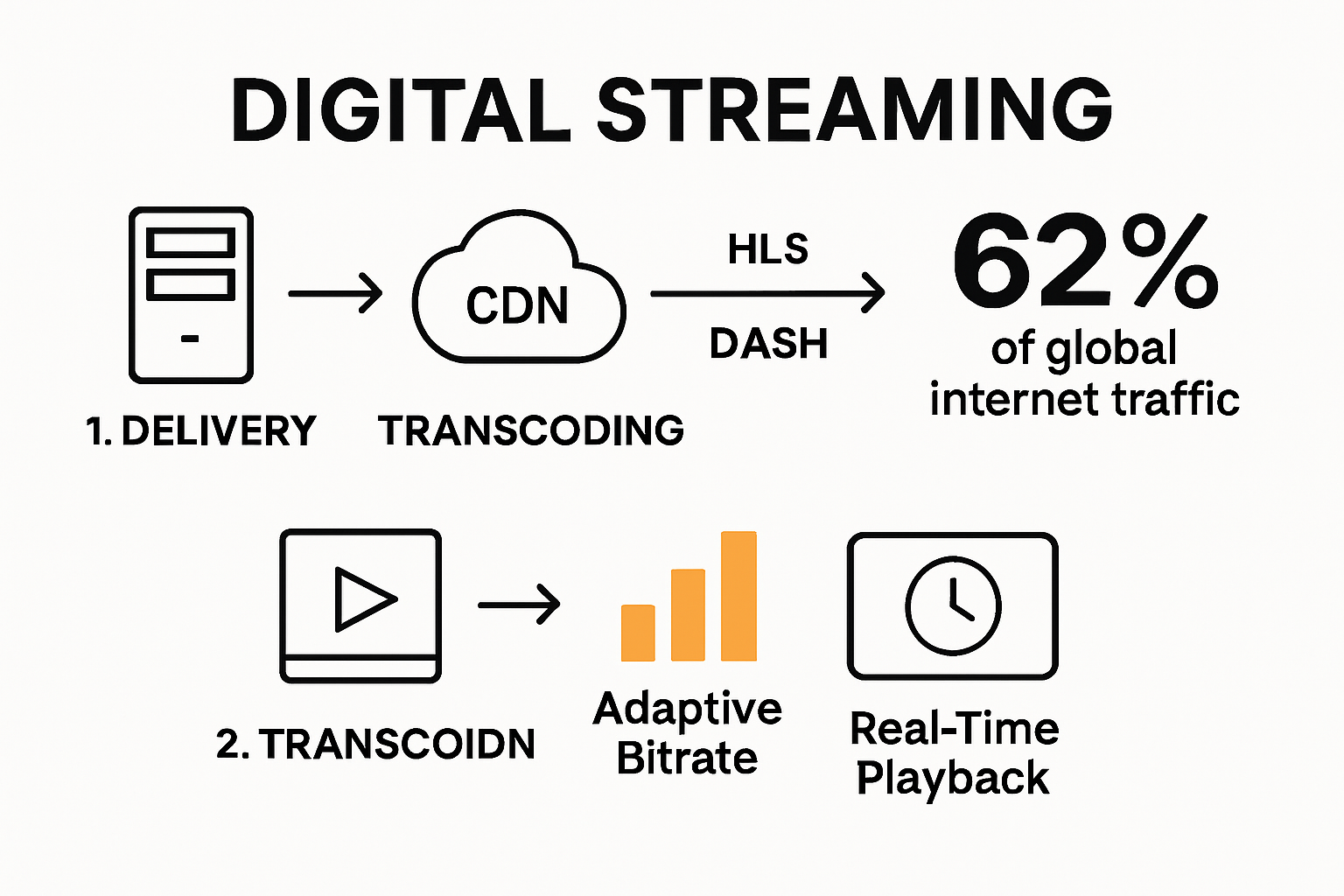
Critical Technical Components:
- Content encoding and compression algorithms
- Adaptive bitrate streaming technologies
- Network protocols for efficient data transmission
- Buffer management systems
Protocols and Technical Infrastructure
Streaming relies on advanced network protocols like HTTP Live Streaming (HLS) and Dynamic Adaptive Streaming over HTTP (DASH). These protocols enable intelligent content delivery by dynamically adjusting video quality based on available internet bandwidth. Real time adaptation ensures viewers experience minimal buffering and optimal viewing quality.
According to IEEE Communications Society, modern streaming infrastructures can adjust video quality up to 10 times per minute, providing unprecedented responsiveness to changing network conditions.
Learn more about the technological evolution of media transmission
Key Components of Digital Streaming Services
Digital streaming services represent complex technological ecosystems comprising multiple interconnected components that work seamlessly to deliver content efficiently and effectively. These sophisticated platforms integrate advanced technologies to provide users with smooth, personalized media consumption experiences.
Content Management and Distribution
Content management represents the foundational infrastructure of streaming services, involving comprehensive systems for acquiring, storing, and distributing digital media. These systems handle massive libraries of content, ensuring rapid retrieval and transmission across global networks. Robust content delivery networks (CDNs) play a critical role in maintaining high performance and reducing latency during media streaming.
Essential Content Management Functions:
- Media ingestion and metadata tagging
- Content encoding and transcoding
- Digital rights management
- Scalable storage solutions
User Experience and Technical Infrastructure
Streaming platforms deploy sophisticated algorithms and technical infrastructure to create personalized, responsive user experiences. Recommendation engines analyze user viewing patterns, utilizing machine learning to suggest relevant content. These systems simultaneously manage user authentication, payment processing, and real time streaming quality adjustments.
According to Akamai Technologies Research, effective streaming infrastructure requires multiple redundant systems to ensure continuous service availability and optimal performance.
The Future of Digital Streaming in Media
Digital streaming is poised to revolutionize media consumption, transcending traditional boundaries and creating immersive, personalized entertainment experiences. Emerging technologies are rapidly transforming how audiences interact with digital content, pushing the boundaries of conventional media distribution and consumption models.
Technological Convergence and Innovation
The future of streaming will be characterized by unprecedented technological integration. Artificial intelligence and machine learning will play crucial roles in creating hyper personalized content recommendations, adapting in real time to individual viewer preferences. Streaming platforms will become intelligent ecosystems that understand and anticipate user desires, blurring the lines between content consumption and interactive experiences.
Key Emerging Streaming Technologies:
- Artificial intelligence driven content curation
- Immersive augmented and virtual reality streaming
- Advanced adaptive streaming technologies
- Integrated cross platform content experiences
Global Content and Accessibility Trends
Streaming services are expanding global content accessibility, breaking down geographical and cultural barriers. Multilingual content and localized programming will become standard, enabling viewers to access diverse cultural narratives from around the world. This global approach will democratize media consumption, providing platforms for underrepresented voices and storytelling traditions.
According to Deloitte’s Digital Media Trends Survey, consumers increasingly expect personalized, on demand content experiences that transcend traditional media boundaries.
Explore the ongoing evolution of entertainment platforms
Frequently Asked Questions
What is digital streaming?
Digital streaming is a method of consuming media content in real time over the internet without downloading entire files. It allows users to watch videos, listen to music, or access other media content instantly on connected devices.
How does digital streaming work?
Digital streaming works by transmitting data packets over the internet to deliver content continuously. While you watch or listen, your device receives and processes these packets, enabling seamless playback without the need for complete downloads.
What are the advantages of using digital streaming services?
The advantages of digital streaming services include instant access to vast libraries of content, personalized recommendations, and cost-effectiveness compared to traditional media subscriptions, along with access to global content from diverse cultures.
What technology underpins digital streaming?
Digital streaming relies on various technologies, including advanced compression algorithms, adaptive streaming protocols like HTTP Live Streaming (HLS) and Dynamic Adaptive Streaming over HTTP (DASH), and content delivery networks (CDNs) to ensure efficient and high-quality data transmission.