
What is Exclusive Content? Understanding Its Impact
Exclusive content is everywhere and it is changing the way we interact with digital media. More than 60 percent of new streaming subscribers sign up just to access exclusive shows or movies. That may sound like ordinary competition among platforms. What surprises people is how the real power lies in the psychology of exclusivity—shaping not just what you watch but even who you think you are.
Table of Contents
- Defining Exclusive Content: What It Is And What It Includes
- The Importance Of Exclusive Content In The Streaming Era
- How Exclusive Content Influences Viewer Behavior And Choices
- Key Concepts Surrounding Exclusive Content: Types And Examples
Quick Summary
| Takeaway | Explanation |
|---|---|
| Exclusive content is unique and limited | This type of content is only available through one specific platform or creator, providing a distinct competitive advantage. |
| Scarcity enhances perceived value | The limited availability of exclusive content makes it more attractive to viewers, driving subscription choices and revenue potential. |
| Strategic content development is essential | Platforms must understand audience preferences and balance production costs with engaging content to maximize impact. |
| Exclusive content fosters viewer loyalty | Unique offerings encourage longer engagement, commitment to platforms, and increased social interaction among viewers. |
| Quality is key to differentiation | High-quality, original content stands out in a saturated market and justifies premium pricing for platforms. |
Defining Exclusive Content: What It Is and What It Includes
Exclusive content represents a specialized form of media or information that is uniquely produced, distributed, or accessible through a single platform, creator, or channel. Unlike standard content available across multiple sources, exclusive content creates unique value by offering something that cannot be found elsewhere.
Core Characteristics of Exclusive Content
Exclusive content distinguishes itself through several fundamental attributes:
- Limited Availability: Content accessible only through one specific channel or platform
- Unique Production: Specially created material not replicated by other sources
- Strategic Value: Designed to attract and retain audience attention
According to Legal Insider’s definition, exclusive content fundamentally means material that remains unavailable to other persons or platforms, creating a distinct competitive advantage for its original distributor.
Types of Exclusive Content
Exclusive content manifests in various formats across different industries:
- Digital Media: Original streaming series produced by platforms like Netflix or Amazon Prime
- Entertainment: Artist album releases exclusive to specific music platforms
- Publishing: Research reports or academic papers accessible only through specialized databases
These variations demonstrate how exclusive content serves as a strategic tool for engagement, differentiation, and audience retention across multiple domains.
To clarify the main types of exclusive content discussed in the article and their distinguishing features, the following table summarizes each category and its description.
| Category | Description | Example |
|---|---|---|
| Platform-Specific Originals | Content made for and only available through one service | “Stranger Things” on Netflix |
| Time-Limited Exclusivity | Available on a specific platform for a set period | Movies debuting on one service before anywhere else |
| Geographic Exclusivity | Restricted to certain regions or markets | Shows only accessible to users in select countries |
| Music Platform Exclusivity | Album or song accessible via one streaming service | Spotify exclusive album releases |
| Publishing Exclusivity | Research/content only available in certain databases | Academic journals with limited access |
| Gaming Exclusivity | Games available only on a specific console or service | Console-exclusive game titles |
Strategic Importance in Modern Media
In an increasingly saturated media landscape, exclusive content represents a critical strategy for standing out. Platforms and creators invest significant resources in developing unique material that cannot be easily replicated, understanding that scarcity drives perceived value. Whether through original documentaries, investigative journalism, or specialized research, exclusive content provides audiences with compelling reasons to choose one platform over another.
The Importance of Exclusive Content in the Streaming Era
In the rapidly evolving digital media landscape, exclusive content has become a critical strategic asset for streaming platforms. As competition intensifies, the ability to offer unique, compelling content represents a key differentiator in attracting and retaining audiences.
Driving Subscriber Acquisition and Retention
Exclusive content serves as a powerful mechanism for platforms to distinguish themselves in a crowded marketplace. By producing original series, documentaries, and films that cannot be found elsewhere, streaming services create compelling reasons for viewers to subscribe and stay.
Research from Carnegie Mellon University highlights that strategic content release methods can significantly impact user engagement. Gradually releasing shows, for instance, can foster deeper platform exploration and increase subscription rates.
Economic Implications for Content Creators
The rise of exclusive content has transformed economic models within the entertainment industry. Streaming platforms now invest substantial resources in original productions, recognizing that unique content represents a competitive advantage. Key economic impacts include:
- Higher Subscriber Value: Original content attracts premium subscribers
- Reduced Licensing Costs: Creating in-house content eliminates expensive third-party licensing fees
- Global Market Expansion: Unique content can appeal across international markets
For viewers seeking more context about digital entertainment, our guide to digital streaming offers additional insights into these transformative media trends.
Strategic Content Development
Successful exclusive content strategies require nuanced understanding of audience preferences. Platforms must balance production costs with potential audience engagement, carefully selecting projects that resonate with their target demographic. Quality and originality remain paramount, with audiences increasingly valuing innovative storytelling and diverse perspectives over mere content quantity.
How Exclusive Content Influences Viewer Behavior and Choices
Exclusive content has fundamentally transformed how audiences engage with digital media, creating complex psychological and behavioral patterns that extend far beyond traditional entertainment consumption. By offering unique, unavailable experiences, platforms strategically shape viewer preferences and decision making processes.
Psychological Drivers of Content Selection
Viewers are increasingly motivated by the fear of missing out when it comes to exclusive content. This psychological phenomenon drives subscription choices and viewing behaviors, compelling audiences to invest in platforms offering distinctive programming. Narrative scarcity becomes a powerful motivator, with viewers feeling compelled to access content they perceive as unique or limited.
According to research on gratification cultivation theory, enjoyment and narrative engagement can significantly influence cultural acceptance and subsequent media consumption patterns. Exclusive content taps into this psychological mechanism, creating deeper emotional connections with audiences.
Behavioral Engagement Patterns
Exclusive content triggers several key behavioral responses:
- Platform Loyalty: Viewers commit to specific streaming services
- Extended Viewing Time: Unique content encourages longer engagement
- Social Discussion Participation: Rare content generates more conversation
For those interested in understanding related viewing trends, our guide to binge watching provides additional context about modern media consumption behaviors.
Economic and Social Signaling
Choosing platforms with exclusive content has become a form of social signaling. Viewers demonstrate cultural awareness and sophistication by accessing unique programming. Subscription choices now reflect personal identity more than ever before, with exclusive content serving as a marker of social capital.
The economic implications are profound: platforms that successfully curate distinctive content portfolios can command premium subscription rates and attract more discerning audiences. By understanding and leveraging these complex viewer dynamics, streaming services transform exclusive content from mere entertainment into a strategic competitive advantage.
Key Concepts Surrounding Exclusive Content: Types and Examples
Exclusive content represents a multifaceted strategy across various media platforms, encompassing different formats and approaches designed to capture audience attention and create unique value propositions.
Categorization of Exclusive Content
Exclusive content can be broadly classified into several distinct categories that serve different strategic purposes
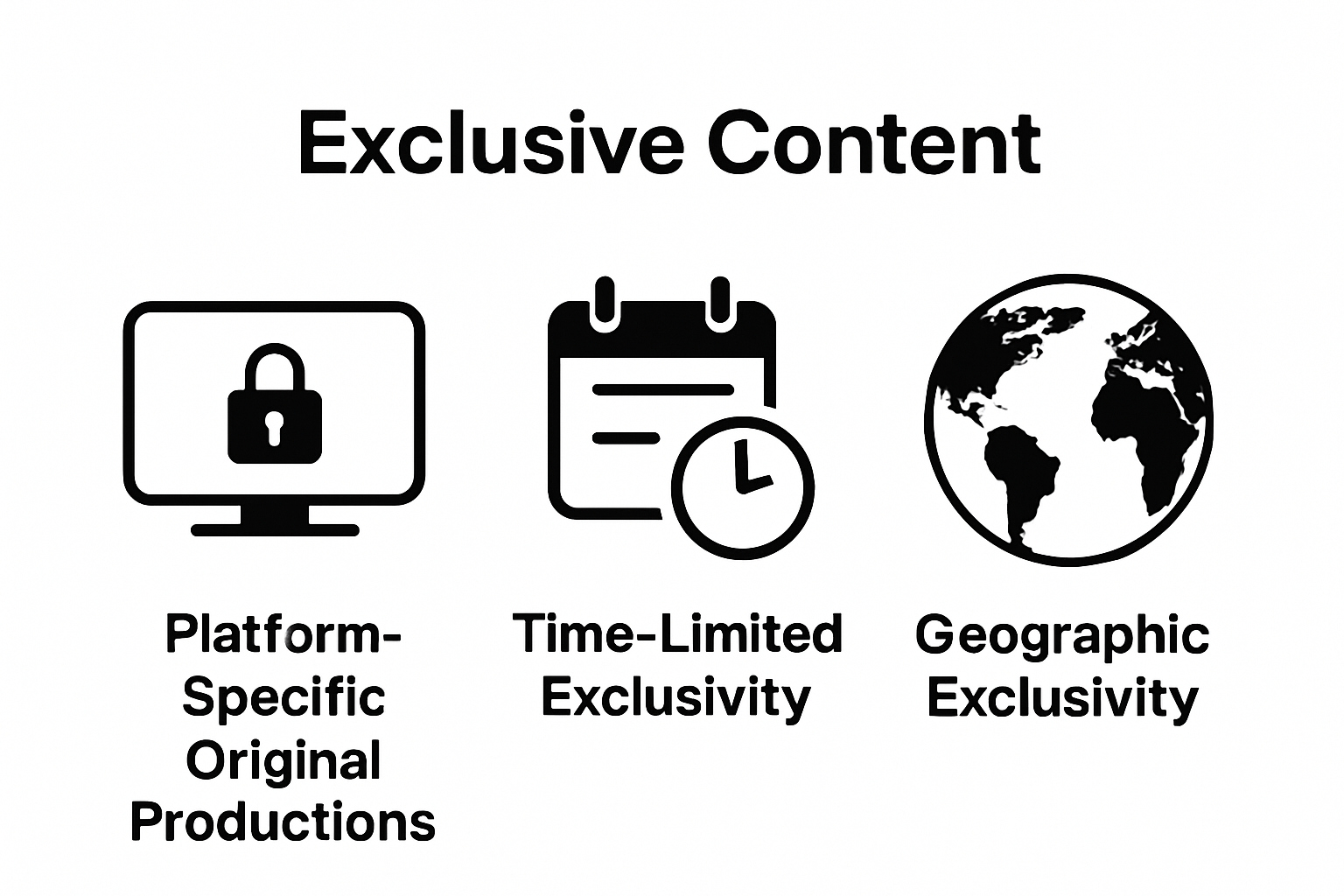 :
:
- Platform-Specific Original Productions: Content created exclusively for a single streaming service or media platform
- Time-Limited Exclusivity: Content available only on one platform for a predetermined period
- Geographic Exclusive Content: Media restricted to specific regional markets
Temporal exclusivity emerges as a particularly powerful mechanism, where platforms secure temporary rights to distribute content before wider release. This approach creates anticipation and urgency among potential viewers.
Practical Examples Across Industries
Different sectors implement exclusive content strategies with nuanced approaches:

- Streaming Services: Netflix originals like “Stranger Things”
- Music Platforms: Spotify exclusive album releases
- Gaming: Console-specific game titles
- Publishing: Academic journals with restricted access research
For viewers interested in understanding related content distribution methods, our guide to syndicated content provides additional insights into media strategies.
Strategic Implementation Considerations
Successful exclusive content strategies require sophisticated understanding of audience preferences and market dynamics. Platforms must carefully balance production costs, potential audience engagement, and competitive positioning. Quality remains the fundamental differentiator, with audiences increasingly discerning about the content they choose to consume.
The economic model underlying exclusive content revolves around creating perceived value that transcends traditional content offerings. By developing unique, high-quality experiences unavailable elsewhere, platforms can justify premium pricing and attract more dedicated audience segments.
Unlock Exclusive Content With Smarter TV Choices
Are you frustrated by how streaming platforms make it hard to find unique shows and movies? The article highlights the challenge of missing out on exclusive content and the struggle to keep up with limited releases and special premieres. You want to capture every trending series and movie as soon as it lands, but the fast pace of exclusives can leave you behind.

Stay ahead of the crowd and guarantee you never miss out on premium titles. Start using SpareTimeTV’s comprehensive TV guides and streaming updates to track top-rated shows, exclusive debuts, and trending content across all major platforms. Take control of your entertainment experience and get instant access to timely streaming updates and curated lists of current trending titles. Visit SpareTimeTV now to discover what exclusive content awaits you this week.
Frequently Asked Questions
What is exclusive content?
Exclusive content refers to media or information that is uniquely produced and accessible through a single platform, creator, or channel, providing unique value that cannot be found elsewhere.
Why is exclusive content important for streaming platforms?
Exclusive content is crucial for streaming platforms as it helps them distinguish themselves in a competitive market, attracting and retaining subscribers by offering unique programming that encourages ongoing engagement.
What types of content can be considered exclusive?
Exclusive content can include platform-specific original productions, time-limited exclusives, and geographic exclusives, spanning formats like streaming series, music albums, and academic research papers.
How does exclusive content influence viewer behavior?
Exclusive content influences viewer behavior by fostering platform loyalty, encouraging extended viewing time, and generating social discussions, as audiences are drawn to unique programming that creates a fear of missing out.