
What is TV Upscaling? Understanding How It Works
TV upscaling has quietly changed the way we watch everything from classic movies to live sports. Many people think watching a crisp 4K or 8K image means you always need brand new ultra-high-resolution content. Not true. Over 80 percent of TV and streaming content is still created in lower resolutions and upscaling uses smart tech to make those old visuals look surprisingly sharp on even the newest screens.
Table of Contents
- Defining TV Upscaling: What Is It?
- The Importance of TV Upscaling for Viewers
- How TV Upscaling Works: The Technology Behind It
- Key Concepts in TV Upscaling: Resolution and Image Quality
- Real-World Applications of TV Upscaling in Streaming and Viewing
Quick Summary
| Takeaway | Explanation |
|---|---|
| TV upscaling enhances lower-resolution content | Upscaling uses advanced processing techniques to improve the visual quality of standard definition media. |
| Modern TVs utilize machine learning for upscaling | Advanced algorithms predict and reconstruct image details, enhancing older content significantly. |
| Upscaling makes high-resolution viewing accessible | Viewers can enjoy legacy media without needing to purchase new formats, extending media lifespan. |
| Image quality depends on original content resolution | Upscaling effectiveness varies based on the source material’s inherent quality and the TV’s capabilities. |
| Key upscaling methods include interpolation techniques | Techniques like bilinear and bicubic interpolation aid in generating improved pixel detail during the upscaling process. |
Defining TV Upscaling: What Is It?
TV upscaling represents a sophisticated digital image processing technique designed to enhance the visual quality of lower resolution video content by intelligently expanding its pixel count and perceived detail. At its core, upscaling transforms standard definition or lower resolution images into higher resolution displays without requiring original high-resolution source material.
The Technical Mechanics of Upscaling
When a television receives a lower resolution signal, its internal processor must strategically create additional pixels to fill the screen. According to MIT’s Computer Vision Research, this process involves complex interpolation algorithms that predict and generate missing pixel information. The goal is not simply to stretch existing pixels but to intelligently estimate and construct new visual data.
Key Upscaling Mechanisms Include:
- Pixel Interpolation: Calculating intermediate pixel values between existing data points
- Edge Detection: Identifying and preserving sharp image boundaries during resolution increase
- Noise Reduction: Minimizing visual artifacts introduced during pixel generation
Understanding Upscaling Limitations
While upscaling can dramatically improve image presentation, it cannot magically create genuine high-resolution detail that did not originally exist. The SMPTE conference research emphasizes that upscaling algorithms can enhance perceived image quality but cannot introduce completely new visual information beyond the source material’s inherent resolution.
Moreover, the effectiveness of upscaling varies significantly depending on the source content’s original quality, the display’s processing capabilities, and the sophistication of the television’s internal algorithms. Modern smart TVs increasingly employ advanced machine learning techniques that can more accurately predict and reconstruct missing image details, providing increasingly impressive visual transformations.
Ultimately, TV upscaling represents a remarkable technological bridge between legacy content and contemporary high-resolution display technologies, enabling viewers to enjoy older media with improved visual clarity and reduced pixelation.
To help clarify how different upscaling algorithms work, here is a comparison of commonly used techniques and their application in TV upscaling.
| Upscaling Method | How It Works | Typical Result on Screen |
|---|---|---|
| Nearest Neighbor | Duplicates existing pixels to fill space | Simple, can look blocky |
| Bilinear Interpolation | Averages colors of adjacent pixels | Smoother but may blur details |
| Bicubic Interpolation | Uses weighted average of multiple surrounding pixels | Sharper, with better edge quality |
| Machine Learning (AI) | Predicts and reconstructs pixel details using data | Most realistic, preserves detail |
The Importance of TV Upscaling for Viewers
TV upscaling has become increasingly critical for viewers as display technologies continue to advance, creating a bridge between legacy content and modern high-resolution screens. With the proliferation of 4K and 8K televisions, the ability to transform lower-resolution content into visually appealing displays has become a fundamental expectation for consumers seeking optimal viewing experiences.
Enhancing Viewer Experience
The primary value of upscaling lies in its ability to maximize the potential of existing media libraries. According to the Consumer Technology Association, modern televisions must be capable of converting content across multiple resolutions, ensuring viewers can enjoy their favorite movies, shows, and archived content with improved visual clarity.
Key Benefits for Viewers Include:
- Preservation of existing media collections
- Improved visual quality on larger screens
- Cost-effective solution for enjoying high-resolution displays
Economic and Content Accessibility Implications
Upscaling represents more than just a technical improvement. It addresses a critical challenge in the entertainment ecosystem: the gap between available content and display technologies. Most broadcast and streaming content still exists in lower resolutions, making upscaling crucial for exploring the future of TV viewing.
Advanced machine learning techniques now enable televisions to intelligently reconstruct images, adding details that were previously lost. This technological innovation means viewers can experience older content with unprecedented visual richness, effectively extending the lifespan and enjoyment of media collections.
Moreover, upscaling democratizes access to high-quality viewing experiences. Viewers no longer need to repeatedly purchase content in newer formats or replace entire media libraries. Instead, they can leverage sophisticated processing technologies to transform existing content, making high-resolution viewing more accessible and affordable.
How TV Upscaling Works: The Technology Behind It
TV upscaling represents a sophisticated digital transformation process where complex algorithms intelligently reconstruct visual information, converting lower resolution images into higher resolution displays. Understanding the intricate mechanisms behind this technology reveals the remarkable computational techniques that breathe new life into legacy media content.
Interpolation: The Core Computational Strategy
According to MIT’s Computer Vision Research, interpolation serves as the fundamental computational strategy in upscaling. The process involves strategically predicting and generating additional pixel information by analyzing surrounding pixel values and applying mathematical models to estimate missing visual details.
Primary Interpolation Techniques Include:
- Nearest Neighbor: Duplicating existing pixel values
- Bilinear: Averaging surrounding pixel colors
- Bicubic: Calculating weighted averages using more surrounding pixels
- Advanced Machine Learning: Predictive pixel reconstruction using neural networks
Machine Learning and Artificial Intelligence Advancements
Modern upscaling technologies have transcended traditional interpolation methods by incorporating artificial intelligence and machine learning techniques. These advanced systems can now intelligently reconstruct visual information by training on massive datasets of high and low-resolution images, enabling more nuanced and contextually aware image enhancement.
The integration of deep learning models allows televisions to recognize complex visual patterns, understand object boundaries, and predict realistic image details that were previously unattainable. This approach goes beyond simple pixel multiplication, effectively reconstructing images with unprecedented detail and clarity.
For viewers interested in exploring the future of TV technology, these computational breakthroughs represent a remarkable intersection of visual science, mathematics, and artificial intelligence. By leveraging sophisticated algorithms, modern upscaling transforms how we experience legacy media content on contemporary high-resolution displays.
Key Concepts in TV Upscaling: Resolution and Image Quality
TV upscaling represents a complex intersection of digital signal processing and visual perception, where technological innovation meets the human eye’s remarkable ability to interpret visual information. Understanding the fundamental relationship between resolution, pixel density, and perceived image quality is crucial for comprehending how upscaling technologies transform viewer experiences.
Understanding Resolution Fundamentals
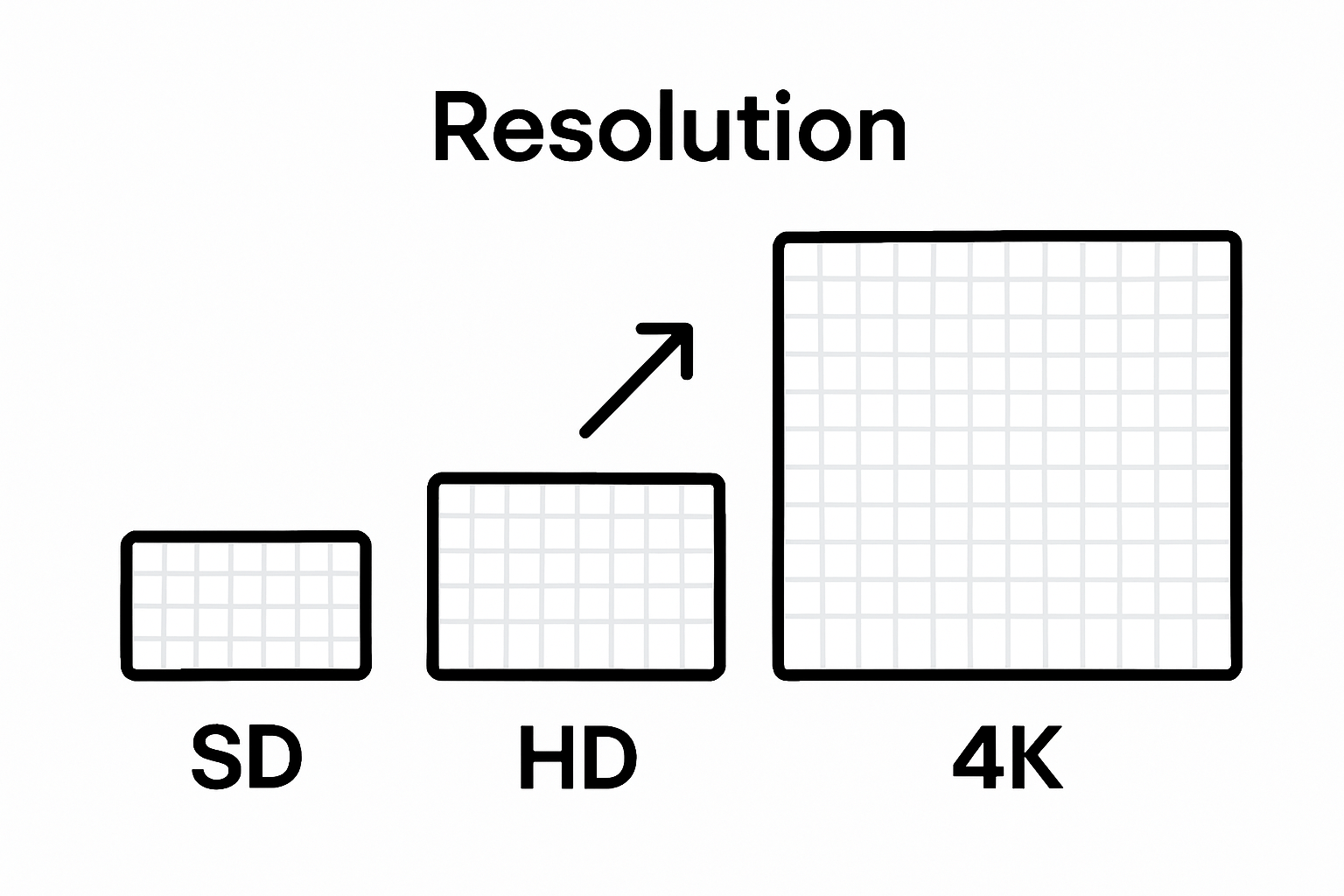
According to ITU Television Standards, television resolution defines the total number of pixels horizontally and vertically displayed on a screen. Modern display standards range from High Definition (1920×1080 pixels) to Ultra High Definition (4K at 3840×2160 pixels) and even 8K (7680×4320 pixels).
**Critical Resolution Categories Include:
**
- Standard Definition (SD): 640×480 pixels
- High Definition (HD): 1280×720 or 1920×1080 pixels
- 4K Ultra HD: 3840×2160 pixels
- 8K Ultra HD: 7680×4320 pixels
Image Quality and Perceptual Complexity
Image quality goes beyond mere pixel count. Upscaling technologies must navigate complex perceptual challenges, reconstructing visual information that appears natural and detailed. Sophisticated algorithms analyze surrounding pixel contexts, predicting and generating additional visual data that mimics the original content’s visual characteristics.
Advanced machine learning models now enable televisions to recognize intricate visual patterns, understanding object boundaries and predicting realistic image details with unprecedented accuracy. This approach transcends traditional interpolation, effectively reconstructing images that maintain visual integrity across different resolution scales.
For viewers curious about exploring the future of TV technology, these computational breakthroughs represent a fascinating convergence of visual science, mathematics, and artificial intelligence. Modern upscaling transforms how we perceive and experience media content on contemporary high-resolution displays.
This table summarizes the main TV resolution categories discussed in the article along with their typical pixel counts for easier reference.
| Resolution Category | Pixel Dimensions | Common Use Cases |
|---|---|---|
| Standard Definition | 640×480 | Older broadcasts, DVDs |
| High Definition | 1280×720 or 1920×1080 | HDTV, Blu-ray, live sports |
| 4K Ultra HD | 3840×2160 | Modern TVs, streaming, discs |
| 8K Ultra HD | 7680×4320 | Latest high-end TVs |
Real-World Applications of TV Upscaling in Streaming and Viewing
TV upscaling has transformed how viewers consume content across various platforms, bridging the gap between legacy media and modern high-resolution displays. As streaming services and digital content continue to proliferate, upscaling technologies play a crucial role in delivering optimal viewing experiences across diverse devices and resolutions.
Streaming Platform Innovations
According to the Consumer Technology Association, streaming platforms increasingly rely on sophisticated upscaling techniques to adapt content for different screen sizes and resolutions. This technological approach ensures that viewers receive the best possible visual experience, regardless of the original content’s resolution.
Key Streaming Upscaling Applications:
- Adaptive bitrate streaming for multiple device types
- Real-time content resolution optimization
- Preserving visual quality across different screen sizes
- Minimizing bandwidth requirements for high-quality playback
Practical Viewing Experience Enhancements
Modern televisions and streaming devices now incorporate advanced machine learning algorithms that intelligently reconstruct visual information. These technologies dynamically analyze and enhance incoming video signals, effectively transforming lower-resolution content into visually appealing displays that approach native high-resolution quality.
The practical implications extend beyond simple pixel multiplication. By leveraging complex computational techniques, upscaling technologies can intelligently predict and reconstruct missing visual details, creating a more immersive viewing experience. This approach is particularly valuable for viewers with digital streaming platforms, allowing them to enjoy older content on contemporary high-resolution displays without significant quality degradation.
Ultimately, TV upscaling represents a critical technological bridge, enabling viewers to experience a wide range of media content with unprecedented visual clarity and detail across multiple platforms and devices.
Frequently Asked Questions
What is TV upscaling?
TV upscaling is a digital image processing technique that enhances the visual quality of lower resolution video content by intelligently increasing its pixel count and perceived detail, transforming standard definition images into higher resolution displays.
How does TV upscaling work?
TV upscaling uses complex interpolation algorithms to predict and generate additional pixels based on existing data. This process includes techniques such as pixel interpolation, edge detection, and noise reduction to create improved visual data for lower resolution sources.
What are the limitations of TV upscaling?
While upscaling can enhance perceived image quality, it cannot create genuine high-resolution detail that did not originally exist. The effectiveness of upscaling varies based on the original content quality, the display’s processing power, and the sophistication of the upscaling algorithms employed.
How does upscaling improve viewing experiences on streaming platforms?
Upscaling plays a key role in streaming services by adapting and optimizing content for different screen sizes and resolutions. This ensures that viewers receive the best possible visual experience, regardless of the original content’s resolution, enhancing overall viewing quality.