
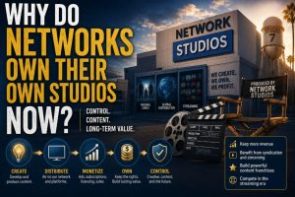
Why Do Networks Own Their Own Studios Now?
If you look at the credits of a modern TV show, you will often notice something interesting. The network airing the show and the studio producing it may belong to the same parent company.
For example, a show may air on a broadcast network while being produced by a studio owned by that same media company. Decades ago, this was much less common.
Today, many major media companies try to keep as much of the television business as possible under one corporate umbrella. They want to produce the show, distribute the show, license the show, stream the show, and profit from the show for years after it first airs.
This shift has fundamentally changed how television operates.
Understanding why networks own studios helps explain modern television economics, streaming strategies, renewals, cancellations, and even why certain shows make it to air while others never do.
Short Answer
Networks increasingly own their own studios because it allows them to keep more revenue, control valuable content, benefit from syndication and streaming rights, reduce dependence on outside companies, and build long-term media franchises.
What Does It Mean for a Network to Own a Studio?
A television network and a television studio perform different jobs.
A network:
- airs programs
- sells advertising
- schedules programming
- attracts viewers
A studio:
- develops shows
- hires writers
- finances production
- owns intellectual property
When a media company owns both, it can control more of the entire process from creation to distribution.
How Television Used to Work
For many years, television networks relied heavily on outside studios.
A network might:
- buy a show
- air the show
- pay licensing fees
Meanwhile, the studio owned the series and collected profits from future syndication and distribution.
This created a system where networks helped make shows successful but did not always benefit from their long-term value.
Many media companies eventually decided that model was not ideal.
Why Networks Wanted Their Own Studios
The answer comes down to ownership.
Television shows can generate revenue for decades through:
- syndication
- streaming
- international licensing
- home entertainment
- merchandise
If a network only airs the show, much of that long-term value belongs to someone else.
Owning a studio allows the company to participate in those future revenue streams.
Instead of renting content, they own it.
The Financial Benefits of Ownership
Owning both the network and the studio creates several advantages.
The company can earn money from:
Production
The studio produces the show.
Distribution
The company sells the show internationally.
Syndication
The show can be licensed for reruns.
Streaming
Episodes can be added to the company’s streaming platform.
Licensing
Content can be licensed to other services.
This creates multiple revenue opportunities from a single television series.
How Syndication Changed the Business
One of the biggest reasons networks became interested in studio ownership was syndication.
Historically, a successful show could become far more valuable after its original run ended.
Series with large episode libraries could generate revenue through:
- local stations
- cable channels
- international broadcasters
Many media executives realized they were helping build valuable franchises without owning the underlying content.
That encouraged companies to invest in their own production operations.
Why Networks Wanted More Control
Ownership provides more than financial benefits.
It also provides control.
Networks can:
- influence creative direction
- control distribution
- manage franchise expansion
- coordinate marketing strategies
This becomes especially important for large entertainment brands.
Owning both the studio and network allows decisions to be made with long-term goals in mind.
Examples of Network-Owned Studios
Today many major television companies operate this way.
Examples include:
Disney
Owns:
- ABC
- Disney Television Studios
NBCUniversal
Owns:
- NBC
- Universal Television
Paramount
Owns:
- CBS
- CBS Studios
Warner Bros. Discovery
Owns:
- HBO
- Warner Bros. Television
FOX
Owns:
- FOX Entertainment
- FOX Entertainment Studios
These companies increasingly prefer producing their own content whenever possible.
The Difference Between a Network and a Studio
Many viewers assume networks and studios are the same thing.
They are not.
Think of it this way:
Studio
Creates the show.
Network
Delivers the show to audiences.
One builds the product.
The other distributes it.
When one company owns both, it controls a larger portion of the television ecosystem.
Why This Matters for TV Renewals and Cancellations
Studio ownership can influence renewal decisions.
Imagine two shows with similar ratings.
Show A:
- produced by the network’s own studio
Show B:
- produced by an outside company
The network may earn more long-term revenue from Show A.
As a result, ownership can become one factor in renewal discussions.
Ratings still matter, but ownership sometimes affects the economics behind those decisions.
The Rise of Media Conglomerates
Beginning in the 1990s and accelerating during the 2000s, major media companies became larger through mergers and acquisitions.
These companies wanted to own:
- networks
- studios
- cable channels
- streaming services
- production companies
The goal was to create vertically integrated businesses capable of generating and distributing content internally.
This strategy became increasingly common across the entertainment industry.
How Streaming Changed Everything
Streaming accelerated the value of ownership.
Companies suddenly needed large content libraries to support services such as:
- Disney+
- Paramount+
- Peacock
- Max
Owning a studio meant owning thousands of hours of programming.
Those libraries became major competitive advantages.
Instead of licensing content from competitors, companies could use their own shows to attract subscribers.
Why Streaming Made Intellectual Property More Valuable
Streaming increased the importance of intellectual property.
Popular franchises can now generate value through:
- television
- streaming
- international licensing
- merchandise
- spin-offs
Companies increasingly view television shows as long-term assets rather than short-term programming.
Ownership became even more important because franchises can continue generating revenue for years.
Are Independent Studios Disappearing?
Not at all.
Independent studios still play an important role in television.
Many successful series continue coming from independent producers.
However, independent studios now face greater competition from vertically integrated media companies that own both production and distribution channels.
The industry continues supporting both models.
What This Means for Viewers
Most viewers never think about who owns a studio.
Yet ownership affects many things audiences notice.
It can influence:
- which shows get renewed
- which franchises expand
- where shows stream
- how content is marketed
- which spin-offs get produced
Some business decisions that seem surprising to viewers make more sense when ownership structures are considered.
Will Networks Continue Owning Studios?
Most industry experts believe ownership integration will remain important.
However, the exact structure may continue evolving because of:
- streaming competition
- changing advertising markets
- mergers
- international expansion
Content ownership remains one of the most valuable assets in modern entertainment.
For that reason, networks are unlikely to give up control of their production operations anytime soon.
Why This Trend Changed Television
The shift toward network-owned studios fundamentally changed television.
In earlier decades, networks primarily focused on attracting viewers.
Today, major media companies think much more broadly.
They want to:
- create content
- own content
- distribute content
- monetize content
- retain long-term rights
This strategy helps explain many of the business decisions shaping modern television.
Final Thoughts
Networks own their own studios because television is no longer just about airing shows. It is about owning valuable intellectual property that can generate revenue across multiple platforms for years or even decades.
The rise of syndication first demonstrated the value of ownership. Streaming later made that value even more important.
Today, major media companies want control over every stage of the content lifecycle—from development and production to distribution and streaming. This approach allows them to maximize revenue, build franchises, strengthen streaming services, and reduce dependence on outside suppliers.
Understanding this relationship helps explain many of the business decisions that shape the television industry today.
Frequently Asked Questions
Why do networks own studios?
Networks own studios so they can keep more revenue, control content, benefit from syndication and streaming rights, and build long-term franchises.
What is the difference between a network and a studio?
A studio creates television shows, while a network distributes those shows to audiences.
Did streaming increase the value of studio ownership?
Yes. Streaming services depend heavily on content libraries, making ownership more valuable than ever.
Does studio ownership affect renewals?
Sometimes. Networks may earn more long-term revenue from shows produced by their own studios.
Are independent studios still important?
Yes. Independent studios continue producing many successful television series, although competition from large media companies has increased.
This topic is part of our guide explaining how television scheduling, economics, and production decisions work.
See the full overview in How TV Works.