
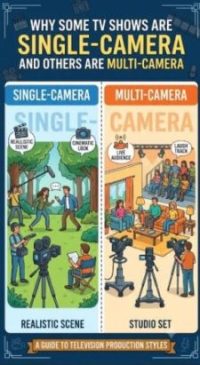
Why Some TV Shows Are Single-Camera and Others Are Multi-Camera
Short Answer: Multi-camera shows are filmed on a soundstage in front of a live studio audience using three or four cameras shooting simultaneously, which is why they look “flatter,” rely on wide sets built like theater stages, and almost always include a laugh track or real audience laughter. Single-camera shows are filmed one shot at a time using cinematic techniques — real locations, moving cameras, no audience — which is why they look and feel more like a movie. The format isn’t a random creative choice: it’s tied directly to genre, budget, and how quickly a network needs to produce episodes. Multi-camera is the traditional home of the studio sitcom; single-camera dominates modern dramas and most current comedies.
Table of Contents
What “Multi-Camera” Actually Means
A multi-camera show is shot with three to four cameras running at the same time, arranged in a fan pattern facing a set built like a three-walled theater box — the “fourth wall” is where the audience and cameras sit. Because every camera is rolling simultaneously, the director can cut between angles in real time, much like a live sports broadcast or a play. Most multi-camera sitcoms are filmed in front of a live studio audience across just a few sets, over the course of a single day, after a week of rehearsal.
This is why multi-camera shows tend to have a distinct look: brighter, flatter lighting (so every camera gets a usable shot), wider blocking so actors can be seen from multiple angles at once, and a laugh track or genuine audience laughter mixed into the final edit.
Examples: Friends, The Big Bang Theory, Seinfeld, How I Met Your Mother.
What “Single-Camera” Actually Means
A single-camera show uses one camera (sometimes two for coverage) filming one setup at a time, the same way a feature film is shot. There’s no live audience, no fixed theater-style set — scenes can be filmed anywhere, indoors or on location, with the camera free to move, follow characters through hallways, or use handheld and tracking shots.
Because each shot is set up and lit individually, single-camera production allows far more visual variety and cinematic technique, but it also takes considerably longer to shoot the same amount of screen time.
Examples: The Office, Breaking Bad, Succession, Ted Lasso.
Where the Multi-Camera Format Came From
The multi-camera technique traces back to early 1950s television, largely credited to Desi Arnaz and cinematographer Karl Freund on *I Love Lucy*. Before that, most sitcoms were broadcast live, which meant no West Coast rerun capability and no way to fix mistakes. Filming with three cameras in front of a live audience solved both problems: it preserved the energy of a live theatrical performance while still producing a recordable, editable, rerunnable piece of film. The format stuck because it was fast, cheap, and reliable — qualities that still matter to networks today.
Why Sitcoms Traditionally Use Multi-Camera
Multi-camera production is built for dialogue-driven comedy performed in front of a reactive audience. A joke lands differently — and a performer can adjust timing — when they can hear real laughter in the room, the same way stand-up comedy works. Because the format relies on a handful of reusable sets (a living room, an office, a coffee shop), it’s also significantly cheaper and faster to produce week after week, which historically made it the default choice for broadcast network sitcoms airing 22+ episodes a season.
Why Modern Comedies Shifted to Single-Camera
Starting in the mid-2000s, shows like *The Office* and *Parks and Recreation* popularized the single-camera, mockumentary-style comedy — no audience, no laugh track, a documentary-style handheld camera. This shift happened for a few converging reasons: streaming and cable didn’t require the same live-audience production pipeline as broadcast, audiences increasingly responded to a more naturalistic, less theatrical comedic style, and single-camera opened up visual storytelling options — reaction shots, physical comedy in real locations, visual gags — that a fixed theater-style set couldn’t support. Today, most new comedies, especially on streaming, default to single-camera; multi-camera sitcoms are comparatively rare, though they haven’t disappeared.
Why Dramas Are Almost Always Single-Camera
Dramas rely on mood, pacing, and visual storytelling in a way multi-camera’s flat, bright, theater-style lighting actively works against. A tense scene benefits from shadow, a tight close-up, a slow push-in — techniques that require deliberate, one-shot-at-a-time camera placement, not four cameras compromising on a single lighting setup to cover a room from every angle. This is also why dramas are shot on location or on detailed, film-style sets rather than three-walled soundstage boxes: the format itself is built around cinematic storytelling rather than capturing a live performance.
The Cost Difference Between the Two
Multi-camera is generally cheaper and faster per episode: fewer setups, reused sets, a full episode often shot in a single day. Single-camera is slower and more expensive: each scene requires its own lighting and camera setup, episodes are frequently shot across multiple locations over several days, and post-production (color grading, sound design, visual effects) tends to be more involved. This is a major reason broadcast networks — who need to fill 22 or more episodes a season on a tight budget — have historically leaned on multi-camera sitcoms, while streaming services, with shorter 8-13 episode seasons and bigger per-episode budgets, can afford single-camera’s slower, costlier pace even for comedies.
How It Affects the Actors’ Performances
Multi-camera acting is closer to theater: performers project to the back of a soundstage, hit marks precisely so every camera gets a clean shot, and often perform the full scene in sequence in front of a live audience, similar to a stage play. Single-camera acting is closer to film acting: more intimate, scenes are shot out of order and often in small fragments, and performers adjust to close-up cameras rather than projecting to a room. Actors who’ve worked in both formats often describe multi-camera as more physically demanding in the moment (a live audience, one shot at getting it right per performance) and single-camera as more mentally demanding over time (maintaining emotional continuity across a scene filmed out of sequence over hours or days).
Shows That Mix or Switch Formats
The two formats aren’t always a hard line. Some shows use a hybrid multi-camera style — several cameras, but no audience or laugh track, filmed more like a drama despite the multi-camera setup (this is sometimes used for reality TV and some modern comedies). It’s rare, but not unheard of, for a show to change formats entirely between seasons if it changes creative direction or moves between networks — though this is a significant, expensive production overhaul, not a minor tweak.
FAQ
Is single-camera or multi-camera more expensive?
Single-camera is almost always more expensive per episode, due to more setups, more locations, and more involved post-production. Multi-camera’s fixed sets and single-day shoots keep costs lower.
Why do multi-camera sitcoms use a laugh track?
Most multi-camera sitcoms are filmed in front of a real studio audience, and the laughter you hear is often genuine audience reaction, sometimes enhanced or supplemented in editing. It’s a byproduct of the format’s theater-style, live-performance production style.
Can a drama be multi-camera?
It’s extremely rare. Multi-camera’s flat lighting and theater-style blocking generally conflict with the visual mood dramas rely on, so the near-universal industry standard is single-camera for drama.
Why did The Office look different from older sitcoms like Friends?
The Office was filmed single-camera, mockumentary-style, with no audience or laugh track — a deliberate departure from the traditional multi-camera sitcom format Friends used, aimed at a more naturalistic, documentary-like comedic tone.
—
Curious how other TV production decisions shape the shows you watch? Explore more of our How TV Shows Are Made page.
This topic is part of our guide explaining how television scheduling, economics, and production decisions work. See the full overview in How TV Works.