
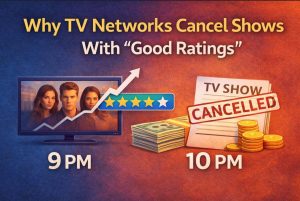
Why TV Networks Cancel Shows With Good Ratings
Short answer:
TV networks sometimes cancel shows with “good ratings” because ratings alone do not determine profitability. Production costs, advertising revenue, syndication value, and long-term strategy often matter more than raw audience size.
Long answer:
A show can appear successful to viewers while still being financially inefficient for a network. If costs rise faster than ad revenue, if ownership is limited, or if syndication prospects are weak, a network may cancel the show despite stable or even strong ratings.
The Big Misunderstanding: Ratings Are Not the Same as Profit
When viewers say:
“This show had good ratings!”
They usually mean:
- It had more viewers than other shows
- It performed well in its time slot
- It had loyal fans
- It trended on social media
Networks look at something different:
- Cost per rating point
- Ad revenue per episode
- Ownership stake
- Long-term library value
A show can rank well and still lose money.
1️⃣ Production Costs Rise Faster Than Revenue
TV production costs typically increase every season.
Why?
- Actor contracts escalate
- Writers and producers renegotiate
- Production complexity increases
- Location and talent expenses grow
Meanwhile:
- Ad revenue may stay flat
- Viewership may decline slightly
- CPM growth may not offset cost inflation
By Season 4 or 5, a once-profitable show may no longer justify its cost.
This also explains concepts discussed in
“How TV Show Actors Make Money”
2️⃣ Ownership Matters More Than Ratings
This is one of the most important — and least understood — factors.
If a network does not fully own a show:
- It may pay a license fee
- It earns only ad revenue
- It may not control syndication profits
- It may share backend revenue
If the studio (not the network) owns the show:
- The long-term library value goes elsewhere
- The network carries more short-term risk
Networks often favor:
Lower-rated shows they own
over
Higher-rated shows they license
Because ownership means long-term asset value.
3️⃣ Syndication Thresholds Change the Equation
Traditionally, shows aimed to reach around:
- 80–100 episodes
That made them attractive for:
- Rerun syndication
- Cable licensing
- International sales
If a show:
- Falls short of that threshold
- Has declining ratings
- Isn’t trending toward strong resale value
…the network may cancel it rather than invest in reaching that number.
4️⃣ Demo Ratings Matter More Than Total Viewers
Advertisers often care more about:
- Adults 18–49
- Adults 25–54
A show may:
- Have high total viewers
- But weak performance in key ad demographics
In that case:
- The show looks successful publicly
- But generates weaker ad revenue
Networks price ads based on demo performance, not just raw audience size.
5️⃣ Schedule Strategy Can Outweigh Loyalty
Sometimes cancellation isn’t about performance at all.
It can be about:
- Making room for a new show
- Reshaping a night’s identity
- Aligning with affiliate expectations
- Protecting a stronger lead-in
A show can be stable — but strategically inconvenient.
6️⃣ Streaming Has Changed the Math
Streaming platforms often:
- Shorten seasons
- Limit long-term contracts
- Avoid traditional syndication models
- Use internal metrics instead of public ratings
A streaming show may appear popular:
- On social media
- In trending lists
But if it doesn’t:
- Reduce churn
- Drive new subscriptions
- Maintain completion rates
…it may be canceled quickly.
Streaming economics prioritize:
Retention efficiency
over
Public perception
7️⃣ The “Good Ratings” Myth
What fans see:
- Ranking
- Viewers
- Buzz
What networks see:
- Margin
- Escalation curves
- Contract cliffs
- Library ownership
- Ad CPM trends
Those perspectives rarely align perfectly.
When Is a Cancellation Actually Surprising?
A cancellation is truly surprising when:
- The network fully owns the show
- Costs are stable
- Demo ratings are strong
- Syndication potential is high
- No major contract escalation is pending
Those cases are rare.
Most cancellations follow financial logic — even if that logic isn’t public.
Frequently Asked Questions
Why do networks cancel shows with loyal fanbases?
Fan loyalty doesn’t always translate to advertising value or profitability. Networks evaluate financial performance, not just passion.
Can a show be canceled even if it wins awards?
Yes. Awards improve prestige but do not guarantee profitability or long-term revenue.
Do streaming services cancel shows for the same reasons?
Streaming services use different metrics, but cost versus retention value still determines survival.
Why are shows often canceled after Season 3 or 4?
Contracts typically escalate around these seasons, increasing costs significantly.
Is cancellation always about low ratings?
No. Ratings are only one factor among many, including ownership, syndication potential, and strategic planning.
How This Connects to Other Scheduling Decisions
Cancellations often relate to:
- Time slot changes
- Affiliate priorities
- Advertising economics
- Break patterns
More details in these pages:
- Why Some TV Shows Air at 10 PM Instead of 9 PM
- Why TV Shows Take Breaks During the Season
- How Network TV Affiliates Work
- Why Is My Show Not New Tonight?
Final Takeaway
A show can look successful and still be financially inefficient.
Networks don’t cancel shows because they dislike them.
They cancel them because:
- Costs rise
- Ownership is limited
- Syndication value is weak
- Ad economics shift
- Strategic priorities change
“Good ratings” is a public measure.
Profitability is a private one.
And the private measure wins.
This topic is part of our guide explaining how television scheduling, economics, and production decisions work.
See the full overview in How TV Works.