
Table of Contents
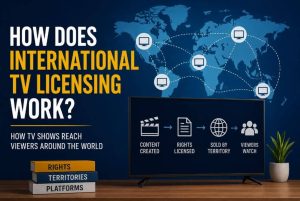
How Does International TV Licensing Work?
Have you ever searched for a TV show on your favorite streaming service only to discover that it is available in another country but not yours?
Or perhaps you’ve noticed that a popular American series premieres months later in Europe, Latin America, or Asia.
The reason usually comes down to one of the least visible—but most important—parts of the television business: international licensing.
Every television show represents valuable intellectual property. Before audiences around the world can watch it, the company that owns the rights must decide who can distribute it, where it can be shown, for how long, and on which platforms.
Those agreements help determine not only where viewers can watch a show, but also how studios recover production costs and earn profits.
Short Answer
International TV licensing is the process of granting broadcasters, cable channels, and streaming services the legal right to distribute a television program in a specific country or region for a defined period of time and on specific platforms. Rights are often sold separately by territory, language, and distribution window.
What Is International TV Licensing?
International licensing is essentially a business agreement.
The owner of a television series gives another company permission to distribute the program in a specific market.
The agreement normally specifies:
- countries or territories
- length of the license
- streaming, broadcast, or cable rights
- language rights
- exclusivity
- financial terms
The company purchasing the rights does not usually buy the show itself.
Instead, it purchases the right to distribute it under agreed conditions.
Why TV Rights Are Sold by Country
Television has traditionally been a local business.
Every country has:
- different broadcasters
- different streaming services
- different languages
- different regulations
- different advertising markets
Because of this, studios generally negotiate separate agreements for different territories instead of selling worldwide rights to a single company.
This allows the content owner to maximize revenue by tailoring deals to each market.
Who Owns the Rights to a TV Show?
The answer depends on how the show was financed.
In many cases, the studio owns the underlying rights.
Examples include:
- television studios
- independent production companies
- streaming platforms that fully finance originals
Sometimes ownership is shared through co-production agreements.
In other cases, streaming platforms purchase worldwide rights while the production company retains certain long-term interests.
Understanding who owns the rights explains why the same show can appear on different platforms in different countries.
The Different Types of TV Rights
A single television series can have many separate licensing agreements.
These may include:
Broadcast Rights
For free over-the-air television.
Cable Rights
For subscription television channels.
Streaming Rights
For on-demand services.
Video-on-Demand Rights
Rental or purchase platforms.
Airline and Hotel Rights
Special entertainment systems.
Educational or Institutional Rights
Used in schools or libraries.
Because these rights can be licensed separately, one show may appear on multiple services under different agreements.
How Networks and Studios Sell Shows Around the World
Major studios employ international distribution teams that negotiate agreements with broadcasters and streaming platforms around the globe.
Some agreements cover:
- a single country
- a language region
- multiple territories
Large international television markets help facilitate these deals, where buyers and sellers negotiate distribution agreements months before programs reach viewers.
Why Streaming Libraries Are Different in Every Country
One of the most common viewer questions is:
“Why does another country have this show but mine doesn’t?”
The answer is usually licensing.
A streaming service may own the rights in one territory while another broadcaster already holds exclusive rights elsewhere.
For example:
Country A
Streaming Service X owns the license.
Country B
A local broadcaster purchased exclusive rights several years earlier.
As a result, viewers receive completely different libraries despite using the same streaming platform.
What Is an Exclusive License?
Many licensing agreements are exclusive.
This means only one company can distribute the program within that territory.
Exclusive agreements help platforms:
- attract subscribers
- differentiate themselves
- market exclusive content
The downside is that viewers may need different services depending on where they live.
Licensing Windows Explained
Rights are also divided by time.
This is known as the licensing window.
A typical sequence may look like:
- Original network broadcast
- Streaming availability
- International television sales
- Additional streaming services
- Syndication
Each stage generates additional revenue for the rights holder.
Different countries may be in different licensing windows at the same time.
Why Shows Sometimes Leave Streaming Services
Licenses eventually expire.
When that happens:
- agreements may be renewed
- another platform may purchase the rights
- the studio may move the show to its own streaming service
This is why titles regularly disappear from streaming libraries.
It is usually a business decision rather than a technical issue.
Why Some Shows Arrive Months Later Overseas
Not every country receives new shows simultaneously.
Delays may occur because of:
- existing licensing contracts
- dubbing
- subtitles
- local marketing campaigns
- regulatory approval
- scheduling strategies
Although global premieres are becoming more common, staggered releases still occur throughout the industry.
How Co-Productions Affect Licensing
Many modern television series involve multiple production partners.
For example:
- an American studio
- a European broadcaster
- an international streaming service
Each company may receive different distribution rights.
These partnerships help reduce financial risk while expanding global distribution opportunities.
Why International Sales Matter Financially
International licensing has become one of the most important revenue sources for television studios.
Selling a successful series overseas can generate income long after its original broadcast.
Revenue may come from:
- broadcast agreements
- streaming licenses
- cable channels
- home entertainment
- future renewals
International distribution often helps producers recover production costs and finance future projects.
How Streaming Changed International Licensing
Streaming has transformed television distribution.
Some platforms now seek worldwide rights so they can launch shows simultaneously across dozens of countries.
Others continue licensing by territory because existing contracts remain in place.
The result is a hybrid system where some productions receive global releases while others continue following traditional regional licensing models.
Why Licensing Is Becoming More Complex
Today’s television business involves far more platforms than it did twenty years ago.
Rights may now be divided among:
- broadcasters
- streaming services
- FAST channels
- international distributors
- airline entertainment
- digital purchases
Each additional platform creates new opportunities—and new negotiations.
This complexity is one reason licensing remains a specialized field within the entertainment industry.
Will Global Licensing Become Simpler?
Probably—but not completely.
Studios increasingly value worldwide releases because they reduce piracy, simplify marketing, and create global events.
However, regional agreements continue generating significant revenue.
As long as different companies compete for exclusive content in different markets, international licensing will remain an essential part of the television business.
Why International Licensing Matters to Viewers
Most viewers never see the contracts behind their favorite TV shows.
Yet those agreements determine:
- where a show is available
- when it premieres
- when it leaves a platform
- whether it receives subtitles or dubbing
- which company can promote it
Understanding licensing helps explain many of the questions viewers ask about streaming and international television.
Final Thoughts
International TV licensing is one of the foundations of the global television industry. It allows studios to earn revenue from multiple markets while giving broadcasters and streaming services access to programming that appeals to local audiences.
Although viewers often notice licensing only when a show is unavailable or disappears from a streaming service, these agreements shape nearly every aspect of how television is distributed worldwide.
As streaming continues expanding and global audiences become increasingly important, international licensing will remain a critical part of how television reaches millions of viewers across different countries and platforms.
Frequently Asked Questions
Why isn’t the same TV show available in every country?
Because distribution rights are often sold separately for different countries or regions.
Can a streaming service lose the rights to a show?
Yes. Most licenses expire after a defined period unless they are renewed.
Why do TV shows leave Netflix or other streaming services?
Usually because the licensing agreement has ended or the rights holder has chosen to distribute the show elsewhere.
What is an exclusive streaming license?
An agreement that gives one platform the sole right to stream a program in a specific territory.
Why are international TV rights valuable?
They allow studios to generate additional revenue by licensing the same television series to broadcasters and streaming services around the world.
This topic is part of our guide explaining how television scheduling, economics, and production decisions work.
See the full overview in How TV Works.